
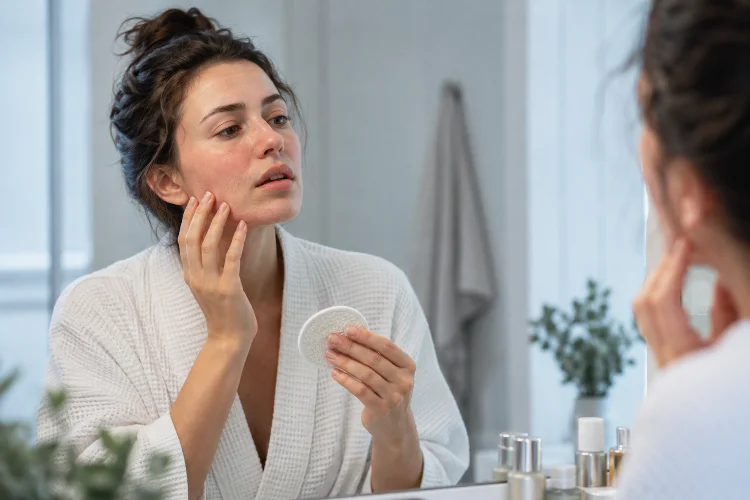
Exfoliation can make skin feel smoother, brighter, and more refined. That early payoff makes it tempting to assume that using stronger acids, exfoliating more frequently, or combining several resurfacing products will simply accelerate the results.
Unfortunately, skin does not work that way.
The outer surface needs enough intact structure to retain water, tolerate environmental exposure, and protect the living tissue underneath.
When exfoliation repeatedly removes surface cells faster than the skin can comfortably recover, that balance can shift from smoother skin to redness, tightness, flaking, sensitivity, and surprisingly rough texture.
Understanding how over-exfoliation changes skin texture and barrier function makes it easier to recognize when a productive routine has become excessive. The issue is not that exfoliation itself is harmful.
Mechanical exfoliants, AHAs, BHAs, retinoids, and other resurfacing treatments can all have useful roles when used appropriately.
The real problem is cumulative stress. Too many products, too much friction, or insufficient recovery can gradually turn a glow-focused routine into a compromised-barrier problem.
What Exfoliation Actually Does to the Skin
Exfoliation removes or loosens cells from the outermost skin surface.
Mechanical methods physically remove those cells through friction, while chemical exfoliants such as glycolic, lactic, or salicylic acid alter the bonds or environment that help retain surface cells.
The American Academy of Dermatology notes that both mechanical and chemical exfoliation can be useful, but the appropriate method and frequency depend on skin type and the strength of the technique. More aggressive exfoliation generally requires less frequent use.
That last point is important.
Skin does not become healthier simply because more dead cells are removed. The stratum corneum – the outermost part of the epidermis – is a functional barrier, not useless material waiting to be scrubbed away.
It helps prevent unwanted substances from entering while reducing excessive water loss from the body.
Exfoliation should therefore refine that layer without continuously destabilizing it.
Over-Exfoliation Can Increase Water Loss
One major consequence of barrier disruption is reduced control over transepidermal water loss, commonly shortened to TEWL.
TEWL describes water moving through the epidermis and evaporating from the skin surface. Research commonly uses it as an indicator of barrier function, with higher measurements generally associated with greater barrier impairment.
The stratum corneum relies partly on organized intercellular lipids and natural moisturizing factors to control that water movement.
When excessive exfoliation disrupts the outer surface, skin may lose water more easily.
This explains one of the strangest signs of over-exfoliation: skin can look shiny yet feel extremely tight.
That shine is not necessarily evidence of excellent hydration. The surface may be unusually smooth, oily, irritated, or stripped while the underlying outer layers are struggling to maintain comfortable water levels.
Adding another acid usually makes the situation worse.
Skin Can Become Rougher Instead of Smoother
People exfoliate because they want smoother texture, so roughness can seem like a reason to exfoliate even more.
This can create a frustrating cycle.
As barrier function becomes disturbed, the normal processes involved in skin-cell maturation and shedding can become less orderly. Hydration itself plays an important role in healthy desquamation, which is the natural shedding of surface cells.
A disrupted surface may therefore become flaky, uneven, tight, or rough.
Foundation may suddenly emphasize areas that were previously smooth. Moisturizer can seem to sit awkwardly on top of the face, while products that never caused problems before may begin to sting.
If texture becomes noticeably worse after increasing exfoliation frequency, do not automatically assume that more resurfacing is needed.
Sometimes roughness is a signal to reduce exfoliation and restore moisture.
Redness and Sensitivity Are Important Warning Signs
A little temporary tingling from some active ingredients does not automatically mean the barrier has been damaged.
Persistent burning, redness, tenderness, or increased sensitivity is different.
The AAD specifically warns that over-exfoliation can leave skin red and irritated. It recommends adjusting exfoliation frequency based on both skin type and how aggressive the exfoliation method is.
Your normal products can provide useful clues.
Perhaps your basic moisturizer suddenly burns. Sunscreen may sting around the nose, or even lukewarm water feels uncomfortable.
That change in tolerance matters.
It suggests the skin is no longer handling routine exposure as well as it normally does.
People with deeper skin tones should also be particularly cautious with aggressive exfoliation because irritation can contribute to unwanted pigmentation changes. The AAD notes that more aggressive exfoliation may increase dark spots in some darker skin tones.
Product Stacking Is Often the Hidden Problem
Over-exfoliation does not always happen because someone uses one extraordinarily strong peel.
More often, several reasonable products quietly add up.
Imagine using a salicylic acid cleanser in the morning, an exfoliating toner at night, a retinoid several evenings each week, and a glycolic mask on Sunday.
Individually, each product may seem manageable.
Collectively, the routine may place significantly more stress on the skin than expected.
Retinoids, benzoyl peroxide, salicylic acid, and other acne treatments can also contribute to dryness and irritation. The AAD specifically recommends moisturizer to help skin tolerate several commonly used acne treatments.
This is why ingredient categories matter more than product count.
A six-product routine containing four resurfacing ingredients may be substantially more aggressive than a ten-product routine dominated by gentle hydration.
Review the entire routine rather than evaluating each product seperately.
Stop Exfoliating When Recovery Becomes the Priority
When skin is clearly irritated, continuing to exfoliate usually does not speed up recovery.
The smarter approach is temporary simplification.
Pause unnecessary acids, scrubs, peels, and other strongly resurfacing treatments. If you are using prescription medication, however, discuss significant changes with the clinician who prescribed it rather than automatically stopping treatment.
During recovery, a simple routine can be enough: gentle cleansing, moisturizer, and appropriate sun protection.
For significantly dry skin, the AAD recommends creams or ointments containing ingredients such as glycerin, dimethicone, petrolatum, or similar moisturizing agents. It also advises avoiding irritating products such as retinoids when skin is excessively dry.
Avoid the temptation to build an enormous “barrier repair” routine overnight.
If ten new products are introduced at once, it becomes difficult to tell whether the skin is actually recovering or reacting to something new.
Simple can be remarkably effective.
Moisturization Supports the Recovery Environment
Barrier recovery requires more than avoiding exfoliants.
Skin also needs enough water and lipid support to restore a comfortable outer surface.
Moisturizers can combine humectants that attract water, emollients that smooth roughness, and occlusive ingredients that reduce evaporation. Ingredients such as glycerol and ceramides may also be recommended for excessively dry skin depending on individual needs.
Apply moisturizer consistently rather than waiting until the face feels painfully dry.
If the skin feels particularly tight after cleansing, applying moisturizer while it remains slightly damp can help preserve more surface hydration.
During this stage, judge progress by comfort as much as appearance.
Reduced burning, less flaking, improved flexibility, and better tolerance of basic skincare are more meaningful signs of recovery than achieving an immediate glossy “glass skin” finish.
Barrier maintainance is rarely dramatic, but consistency matters.
Know When It Is Safe to Exfoliate Again
One common mistake is restarting every active ingredient as soon as visible flaking disappears.
Give the skin time to feel genuinely normal again.
Ideally, basic cleanser, moisturizer, and sunscreen should no longer sting. Persistent redness should have settled, and the complexion should not feel unusually tight or sensitive.
Then reintroduce one exfoliating product gradually.
If you previously used an acid every night, for example, restarting once or twice weekly may reveal that you never needed daily application.
The AAD advises finding an exfoliation schedule appropriate for individual skin type and technique rather than following a universal frequency.
Pay attention to other actives at the same time.
A retinoid, exfoliating acid, acne treatment, and strong vitamin C formula can create more irritation when combined than each product does individually.
A more consistant routine with fewer overlapping actives often produces better long-term texture than repeatedly pushing the skin into irritation.
Prevention Is Easier Than Repeated Barrier Repair
The best way to manage over-exfoliation is not constantly repairing it.
It is avoiding the cycle.
Introduce new acids or resurfacing treatments one at a time. Patch testing can also help identify products that trigger redness, itching, or swelling before they are used widely. The AAD recommends testing new skincare on a small area for seven to ten days when practical.
Also remember that seasonal conditions matter.
A routine tolerated during humid weather may become irritating during colder or drier periods. Likewise, someone beginning a retinoid may need to reduce other exfoliants temporarily.
Skin tolerance is not fixed forever.
Adjust the routine when circumstances change rather than forcing the complexion to follow the same schedule every week of the year.
And if severe burning, swelling, cracking, persistent inflammation, or unusual reactions continue despite simplifying the routine, seek professional dermatologic advice rather than repeatedly experimenting at home.
Over-exfoliation can turn a routine designed to improve texture into one that creates roughness, dehydration, redness, sensitivity, and reduced barrier performance. The problem is usually not exfoliation itself but frequency, intensity, and the combined stress of multiple active products.
Healthy skin needs an intact stratum corneum to control water loss and maintain a comfortable surface. When that system becomes irritated, temporarily reducing resurfacing products and prioritizing gentle cleansing and moisturization gives the barrier a better environment to recover.
Take a look at your current routine before adding your next exfoliant. If several acids, retinoids, scrubs, or acne treatments already overlap, removing one step may improve your complexion more than adding another. Better skin texture often comes from smarter exfoliation – not stronger exfoliation.