
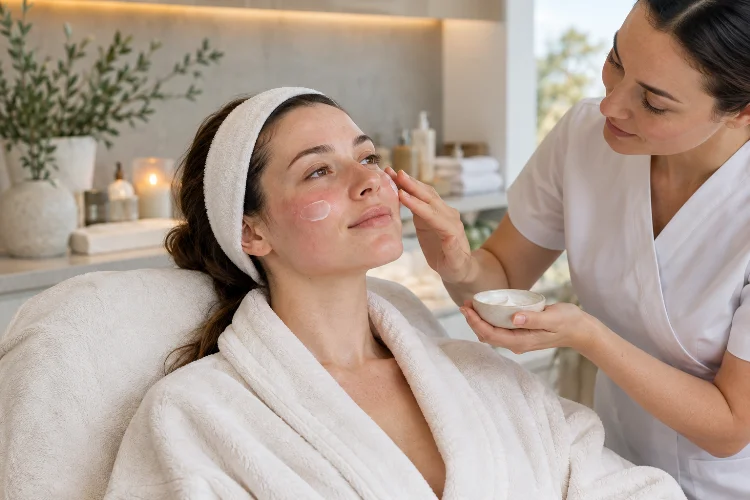
When almost every new skincare product seems to cause stinging, redness, tightness, or mysterious patches of irritation, adding another “miracle” serum is rarely the smartest first move.
Sometimes the skin needs fewer challenges and a better environment for recovery.
Sensitive and reactive skin are not exactly the same thing, and reactions can have many causes. Still, impaired barrier function can contribute to increased water loss and make the skin less effective at keeping potential irritants outside.
The stratum corneum relies heavily on organized lipids – including ceramides, cholesterol, and free fatty acids – to perform that protective job.
That is why advanced barrier repair methods for sensitive and reactive skin focus less on aggressively treating every visible concern and more on rebuilding tolerance.
Gentle cleansing, strategic moisturization, lipid support, reduced irritation, and careful product testing can create a more stable routine.
The objective is not to make skin permanently “reaction-proof.” It is to reduce unnecessary stress and help the complexion become calmer, more comfortable, and better able to handle everyday skincare.
Understand What a Compromised Barrier Actually Means
The outermost portion of the skin acts as both a physical and chemical defense system.
Ceramides, cholesterol, and free fatty acids form organized lipid structures between cells in the stratum corneum. These structures help limit excessive water loss while reducing the entry of irritants, allergens, and microorganisms.
When that system is disrupted, skin may become dry, tight, rough, itchy, or unusually reactive. Products that once felt completely normal can suddenly sting.
Interestingly, research has also found lower facial stratum-corneum ceramide levels in some people identified as having sensitive skin, suggesting a possible connection between lipid composition and sensitivity.
That does not mean every sensitive-skin problem is caused by ceramide deficiency, but it shows why barrier biology matters.
Barrier repair therefore involves more than simply making the face feel moisturized for an hour.
The goal is to support the outer skin structure consistently enough that water retention and tolerance can gradually improve.
Strip the Routine Back Before Adding Repair Products
When skin becomes reactive, people often respond by buying more products.
A calming toner appears, followed by a barrier serum, facial oil, sleeping mask, essence, and recovery balm. Suddenly, irritated skin is being exposed to six unfamiliar formulations.
A simpler strategy is usually easier to evaluate.
The American Academy of Dermatology emphasizes that consistency can matter more than complicated routines and recommends gentle cleansing, fragrance-free moisturizer, and daily broad-spectrum SPF 30 or higher as a simple foundation.
Temporarily reduce non-essential exfoliating acids, scrubs, peels, and other products that reliably sting. If you use prescribed dermatologic medication, however, discuss treatment changes with the clinician who prescribed it rather than automatically stopping.
A minimalist recovery period lets you observe the skin without constantly changing variables.
Once things stabilize, products can be reintroduced seperately instead of all at once.
Cleanse Without Treating Oil Like an Enemy
Cleansing is necessary, but aggressive cleansing can create problems for already-sensitive skin.
The purpose is to remove sunscreen, makeup, excess oil, and debris without leaving the face feeling painfully tight. Harsh scrubbing and overly strong cleansers may increase irritation rather than improve the complexion.
For dry or sensitive skin, the AAD notes that washing once daily in the evening can sometimes be sufficient, depending on individual needs. It also recommends gentle, non-abrasive cleansers.
Pay attention to what happens during the five minutes after cleansing.
Does the skin remain comfortable, or does it immediately feel tight? Does water itself begin to sting? Does moisturizer burn when it normally would not?
Those sensations can provide useful information about current tolerance.
Lukewarm water and gentle hand movements are generally more sensible than hot water, cleansing brushes, rough washcloths, or repeated washing when barrier recovery is the goal.
Rebuild Moisture With More Than One Type of Ingredient
Sensitive skin often needs hydration, but hydration alone is not the complete strategy.
An effective moisturizer may contain humectants that attract water, emollients that soften roughness, and occlusive components that reduce evaporation. Barrier-supportive formulas can also include lipids such as ceramides.
Ceramides are particularly relevant because they naturally work alongside cholesterol and free fatty acids in the stratum corneum.
A scientific review found evidence that properly formulated ceramide products can support damaged lipid organization, although formulation quality is critical.
A separate clinical review examining ceramide-containing preparations found evidence of improved hydration and barrier measures in studies involving dry or barrier-impaired skin, including atopic dermatitis.
This does not mean that every sensitive person needs the most expensive ceramide cream available.
Look for a moisturizer that feels comfortable, does not trigger obvious irritation, and is easy to use consistently.
Barrier maintainance is usually more successful with a boring product you apply every day than an impressive formulation you use twice a month.
Use Occlusion Strategically When Water Loss Is High
Some reactive complexions remain dry even after applying a conventional moisturizer.
In those situations, controlled occlusion may help.
An occlusive layer reduces evaporation from the surface. Petrolatum is a classic example, and the AAD includes petroleum jelly among options that can help soothe certain irritated reactions after the trigger has been removed.
You do not necessarily need to cover the whole face.
Applying a small amount over particularly dry areas – such as around the mouth, cheeks, or flaky patches – may be more comfortable for people who dislike heavy textures.
Occlusion should also be used intelligently. If a product underneath is actively irritating the skin, sealing it beneath an occlusive layer may not magically make the routine safer.
Think of occlusion as a moisture-retention tool, not a way to force problematic actives through sensitive skin.
Create Recovery Windows Between Stronger Treatments
Barrier repair becomes much harder when the skin is exposed to strong active ingredients every night.
Someone might use retinoids on Monday, glycolic acid Tuesday, salicylic acid Wednesday, a peel Thursday, and then wonder why moisturizer burns on Friday.
Recovery days provide breathing room.
On those days, keep the routine focused on cleansing, moisturization, and sun protection rather than continuously asking the complexion to exfoliate, renew, brighten, or clear itself.
You can still use effective active ingredients over the long term. The difference is that intensity should match the skin’s actual tolerance.
Sensitive skin often responds better to a consistant schedule at a lower frequency than cycles of aggressive treatment followed by emergency repair.
Watch for signals such as persistent redness, burning, unexpected flaking, tightness, and a sudden inability to tolerate previously comfortable products.
Those clues may mean the skin needs recovery more than another treatment.
Patch Test Products Before Changing the Whole Routine
Product testing becomes especially useful when your skin reacts unpredictably.
The AAD recommends applying a new skincare product to a small test area twice daily for seven to ten days, using approximately the same amount and contact time you would normally use. If redness, itching, or swelling develops, the product should not be introduced broadly.
This is more informative than applying four new products to your entire face on the same evening.
Also pay attention to fragrance.
The AAD notes that fragrance can trigger irritation or allergic reactions in susceptible individuals and recommends fragrance-free options for sensitive skin. Products labeled “unscented” are not necessarily the same as fragrance-free because fragrance-related ingredients may still be present.
Botanical or “natural” does not automatically mean non-irritating either.
Sensitive skin cares about chemistry, concentration, and exposure – not marketing language.
Protect Recovering Skin From Environmental Stress
Barrier recovery does not happen only at night.
Wind, low humidity, excessive heat, repeated washing, UV exposure, and sudden changes in climate can all affect how comfortable sensitive skin feels.
Daily sunscreen therefore remains important even during a simplified routine. Choose a formula you can tolerate consistently rather than forcing yourself to use one that burns every morning.
Moisturizing immediately after washing is another practical strategy. The AAD recommends applying fragrance-free moisturizer or barrier cream while the skin is still damp in several sensitive-skin and dermatitis contexts because this helps seal in moisture.
Product richness can change with the environment.
A lightweight cream may work perfectly during humid weather but provide too little protection during cold travel or prolonged air-conditioning.
Advanced barrier care is adaptive rather than rigid.
Know When “Sensitive Skin” Needs Professional Evaluation
Not every reaction is simply a weak skin barrier.
Persistent rashes can reflect allergic contact dermatitis, eczema, rosacea, infection, or other dermatologic conditions. Continually buying gentler moisturizers will not necessarily identify the cause.
The AAD notes that allergic contact dermatitis can occur when an ingredient triggers an immune reaction, producing symptoms such as redness, itching, or swelling. Formal patch testing by a dermatologist may sometimes be necessary to identify the culprit.
Seek professional guidance when reactions are severe, persistent, painful, swollen, weeping, cracking, or repeatedly returning despite a simplified routine.
This is particularly important when you cannot identify the trigger.
Advanced barrier care includes knowing the limit of home experimentation.
Sometimes the most effective “repair product” is actually an accurate diagnosis.
Measure Progress by Tolerance, Not Overnight Glow
Barrier recovery is not usually dramatic.
You may not wake up with suddenly perfect texture. More meaningful improvements are often subtle: cleanser no longer stings, moisturizer feels comfortable, flaking decreases, redness settles faster, and the complexion tolerates environmental changes more easily.
That is genuine progress.
A 2026 randomized controlled study of sensitive skin also found that a ceramide-containing emollient was associated with improved barrier function in participants with impaired barriers, measured partly through reduced transepidermal water loss.
The study reinforces that barrier restoration is measurable, but it also highlights that formulations and individual baseline conditions matter.
Think in terms of resiliance rather than perfection.
The best routine is one that keeps the skin stable enough that you do not need to constantly rescue it.
Advanced barrier repair for sensitive and reactive skin is mostly about reducing unnecessary stress while supporting hydration and lipid organization consistently.
Gentle cleansing, fragrance-free moisturization, ceramides, strategic occlusion, recovery days, and careful product testing can all contribute to a calmer routine.
Most importantly, do not confuse more skincare with better barrier repair. Introducing multiple products at once makes reactions harder to understand and can expose already-irritated skin to additional triggers.
Start by simplifying your current routine and identifying which products consistently feel comfortable. Then reintroduce treatments gradually while watching how the skin responds.
If reactions remain severe or repeatedly return, consult a dermatologist rather than continuing trial-and-error skincare indefinitely.