
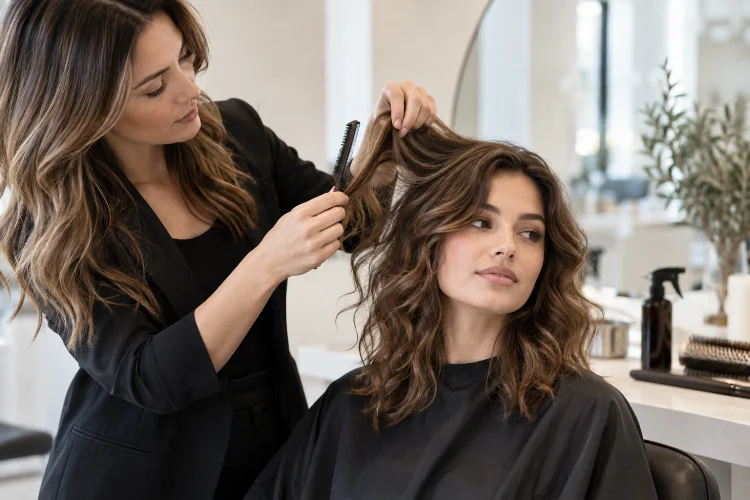
Have you ever copied a styling routine that looked perfect on someone else, only to end up with flat roots, frizz, stiff curls, or a style that disappeared within an hour? The problem may not be your technique. Your hair structure may simply respond differently.
Hair is far more complex than the usual labels of straight, wavy, curly, or coily.
Diameter, cuticle condition, porosity, internal strength, elasticity, chemical history, and even the shape of the fiber can influence how hair absorbs water, reacts to heat, holds a curl, and responds to styling products.
That is where advanced hair structure analysis for better styling performance becomes useful. Instead of choosing products purely by hair type or following universal styling rules, you can match your technique to the actual behavior of the fiber.
Understanding how the hair shaft is built helps explain why some strands need lightweight hold while others perform better with richer conditioning and stronger structural support. Better styling starts with knowing what you are working with.
Start With the Three Main Layers of the Hair Shaft
The visible hair fiber is mainly composed of keratin and contains three structural regions: the cuticle, cortex, and, in some strands, a central medulla.
The cuticle is the outer protective layer. It consists of overlapping flattened cells that surround the cortex, while the cortex makes up most of the hair fiber and contributes heavily to strength, elasticity, and mechanical behavior.
The medulla may be present in the center, although it is not found consistently in every strand.
For styling, the cuticle and cortex matter most.
A smooth cuticle creates lower surface friction and reflects light more evenly, which can make hair appear shinier. When the cuticle becomes chipped, lifted, or worn through repeated heat, bleaching, brushing, or chemical processing, the fiber becomes more vulnerable.
The cortex determines much of the strand’s mechanical strength. Once severe damage reaches this deeper structure, conditioners may improve feel and manageability, but they cannot literally restore the original biological hair fiber.
This is why styling performance should always be considered together with damage history.
Hair Diameter Changes How Much Product You Need
Not all hair strands have the same thickness.
Scientific descriptions of human hair report a wide range in fiber diameter, reflecting major differences between individuals and populations.
In practical styling terms, fine hair generally has less structural mass per strand. Heavy creams, thick oils, and excessive styling products can therefore weigh it down quickly. A small amount of mousse or lightweight volumizer may provide better movement than several rich layers.
Coarser fibers can behave differently.
They may tolerate richer creams, heavier conditioning products, or stronger styling formulations without immediately appearing flat. However, coarse does not automatically mean dry, curly, damaged, or difficult to manage.
Density also matters.
Someone can have extremely fine individual strands but a very dense head of hair. Another person may have coarse individual fibers but relatively low overall density.
Analyzing diameter and density seperately helps prevent oversimplified product choices.
Porosity Tells You How Easily Hair Interacts With Water
Porosity is commonly used to describe how easily hair takes in and loses water.
Cuticle condition strongly influences this behavior. When the outer surface is relatively intact, water penetration and loss tend to be more controlled.
Hair that has experienced substantial bleaching, chemical processing, environmental weathering, or repeated heat may develop a more damaged cuticle and increased susceptibility to moisture movement.
Highly weathered hair can therefore feel dry yet become saturated quickly.
It may also absorb styling products unevenly, develop frizz in humidity, or lose smoothness soon after styling.
Lower-porosity hair can present the opposite challenge. Rich products may accumulate on the surface rather than producing a noticeable improvement in softness.
Instead of relying exclusively on viral “float tests,” observe actual behavior. How quickly does your hair become fully wet in the shower? How long does it take to dry? Do creams disappear quickly or seem to sit on top?
Real-world behavior is often more useful than one simplified porosity test.
Curl Pattern Is Related to Fiber Geometry
Curl pattern is more than a visual category for choosing hairstyles.
Hair fiber shape and follicle geometry contribute to whether a strand grows relatively straight, wavy, curly, or tightly curled.
Scientific literature notes that differences in cross-sectional shape are associated with different fiber forms, although human hair morphology is complex and varies widely.
That geometry affects styling technique.
Straight or slightly wavy hair may require deliberate manipulation and cooling to maintain an artificial curl. Naturally curly hair already contains bends and curves that can create strong visual shape but may also increase points of mechanical stress.
Tightly textured hair often benefits from careful detangling because bending points can make individual fibers more vulnerable to breakage during rough manipulation.
The American Academy of Dermatology specifically notes that tightly curled or textured hair may be best brushed while wet to reduce breakage, whereas many other hair types should be handled minimally when wet because wet fibers can break more easily.
Hair structure therefore changes not just what style you choose, but how you create it.
Elasticity Reveals How the Fiber Handles Stress
Hair needs some flexibility to survive everyday styling.
The cortex contains keratin structures and strong chemical bonds that give the shaft much of its strength and elasticity.
Healthy hair can generally tolerate a degree of stretching and manipulation before returning toward its previous state. Severely compromised hair may respond differently.
For example, chemically overprocessed strands can become unusually weak, overly stretchy when wet, or brittle when dry. Hair that snaps during gentle detangling needs a different styling strategy from resilient hair that tolerates tension comfortably.
This is where styling ambition should match structural condition.
A complex blowout involving high heat, strong brush tension, and repeated passes may produce excellent results on reasonably healthy hair. Applying the same process to bleached, fragile fibers may generate breakage faster than additional shine.
If the hair feels fragile, reducing tension and heat is usually more useful than simply adding more finishing serum afterward.
Chemical History Can Be More Important Than Natural Hair Type
Two people with naturally similar hair can require completely different routines if their chemical histories differ.
Bleaching, permanent coloring, relaxing, perming, and chemical straightening can alter the physical and chemical properties of the hair shaft.
Reviews of cosmetic hair treatments describe structural damage involving the cuticle and cortex, particularly when treatments are repeated or intensive.
Bleached hair, for example, may behave differently from untouched hair even when both started with identical diameter and curl pattern.
The processed section may absorb more conditioning agents, tangle more easily, respond unpredictably to humidity, and require lower heat.
This creates an important styling concept: one head of hair may contain multiple structural conditions simultaneously.
New growth near the scalp may be relatively intact, while older mid-lengths have accumulated mechanical and environmental wear. The ends may have undergone years of washing, brushing, heat, sun exposure, and chemical treatment.
Treating every centimetre identically can therefore produce uneven results.
Heat Styling Should Match Structural Condition
Heat temporarily changes how hair behaves, making it possible to straighten, curl, smooth, or reshape the fiber.
But heat is also a source of damage when exposure becomes excessive.
The American Academy of Dermatology recommends allowing hair to partially air-dry when possible, reducing blow-drying frequency, and using flat irons on dry hair at low or medium heat. It also advises limiting the time curling irons remain in contact with the strand.
The healthiest hair is not automatically permission to use maximum temperature.
Fine, bleached, or already weathered hair generally calls for more conservative settings than resistant, relatively intact coarse fibers.
Technique matters just as much as temperature.
Repeatedly passing an iron over the same section can create more cumulative exposure than making one controlled pass. Likewise, attempting to straighten hair before it is properly detangled can add mechanical tension on top of thermal stress.
The best temperature is the lowest one that achieves the desired result efficiantly.
Hair Weathering Changes Styling Performance Over Time
Hair does not biologically repair itself once it leaves the follicle.
Instead, each strand gradually experiences “weathering,” a term used to describe progressive physical and chemical deterioration of the shaft. UV exposure, brushing, heat, bleaching, chemical treatments, and daily friction can all contribute.
This explains why ends often behave very differently from roots.
Older sections have simply experienced more life.
As the protective cuticle deteriorates, friction can increase, the cortex becomes more exposed, and moisture management becomes less predictable. The hair may tangle faster or require additional conditioning to remain manageable.
Conditioners and styling products can improve lubrication, smooth the surface, and temporarily reduce the visible effects of damage.
That cosmetic improvement is valuable, but it should not be confused with biologically regenerating a heavily damaged strand.
Sometimes the best structural intervention is trimming deteriorated ends while preventing unnecessary damage to newer growth.
Match Hold and Texture Products to Hair Behavior
Once you understand structure, styling products become easier to choose.
Fine, low-density hair often responds well to lightweight mousses, sprays, or root products that provide hold without adding excessive mass. Thick creams or multiple oils may remove volume even if they technically make the strands softer.
Curly or coily hair may benefit from combinations of conditioning and hold. A leave-in product can improve manageability, while gel or mousse can help maintain curl formation as the hair dries.
Highly porous, chemically processed hair may require additional conditioning and surface smoothing before styling.
However, avoid assuming that damaged hair always needs endless protein products.
Hair contains keratin, but product performance depends on formulation, the condition of the fiber, and the desired effect. Too many overlapping treatments can leave some hair feeling stiff or coated.
Evaluate the actual result: softness, detangling, definition, hold, shine, and breakage all provide more useful feedback than marketing categories alone.
Build a Styling Strategy From Structure, Not Trends
The most advanced hair analysis does not require laboratory equipment.
Start by observing diameter, density, natural shape, response to water, chemical history, elasticity, damage distribution, and typical styling behavior.
Then connect those characteristics to technique.
If fine hair collapses quickly, reduce product weight before blaming your haircut. If curls expand dramatically in humidity, focus on film-forming hold and controlled drying. If bleached ends snap while brushing, reduce friction and tension rather than forcing them to behave like untreated roots.
Hair structure creates the limits within which styling works.
Working with those limits usually produces better results than repeatedly trying to overpower the fiber.
Advanced hair structure analysis turns styling from trial and error into a more intentional process.
The cuticle affects surface smoothness, the cortex provides much of the fiber’s strength, while diameter, porosity, curl pattern, elasticity, and chemical history influence how hair responds to products, water, heat, and tension.
There is no single “best” styling routine because hair fibers are structurally different and continue to change as they weather.
Before buying your next styling product, study how your hair actually behaves. Compare the roots, mid-lengths, and ends, notice how quickly they absorb water, and consider previous chemical treatments.
Matching technique to structure can improve hold, shine, definition, and manageability while reducing unneccessary damage.