
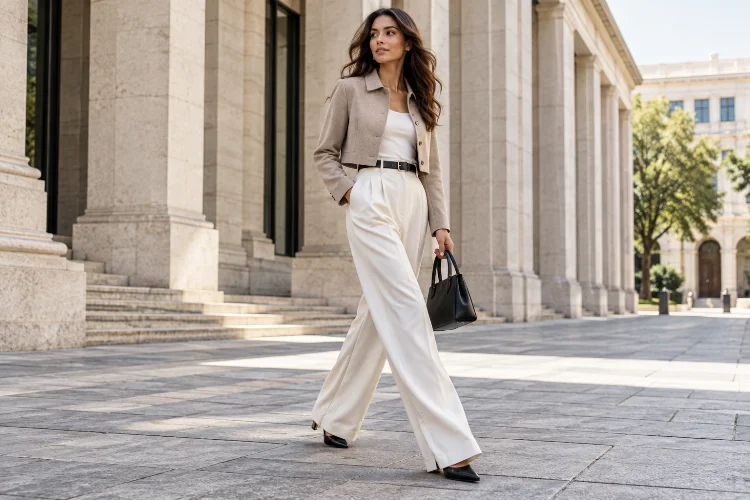
Sometimes an outfit contains all the right pieces and still feels slightly wrong. The trousers are great, the jacket fits, and the shoes make sense, but the overall look somehow feels shorter, heavier, wider, or less intentional than expected.
The missing element is often proportion. In fashion, proportion describes the relationship between different visual sections of an outfit.
The Fashion Institute of Technology identifies proportion as the relationship between parts of a design and emphasizes that individual elements should work with the scale of the whole composition.
Understanding how proportion analysis improves modern personal style decisions makes it easier to choose garment lengths, waist positions, volumes, and layers that support the effect you actually want.
This is not about following rigid rules for a particular body type. Modern proportion styling is much more flexible.
You can deliberately elongate the legs, exaggerate an oversized silhouette, lower the visual waist, or create dramatic volume. The important thing is knowing what each styling decision does visually.
Start With the Relationship Between Torso and Legs
One of the easiest ways to understand proportion is to stop looking at height as a single measurement.
Two people can be exactly the same height but have completely different torso-to-leg proportions. One may have relatively long legs and a shorter torso, while another has a longer torso and shorter-looking leg line.
Clothing can visually change that relationship.
High-rise trousers generally move the perceived waist upward, increasing the amount of the outfit visually assigned to the legs. Lower-rise trousers do the opposite, extending the torso section.
Neither option is automatically better.
If you want a long-legged silhouette, higher waist placement can help. If you want a relaxed, elongated torso or a more deliberately slouchy look, a lower rise may create exactly the effect you want.
The key is choosing intentionally rather than assuming every flattering outfit follows the same formula.
Use Garment Length to Change Visual Divisions
Every hemline creates a visual interruption.
A cropped jacket divides the body differently from a blazer ending below the hip. A midi skirt creates a different proportion from a mini skirt, even when everything else remains unchanged.
This is why changing only one garment length can transform an outfit.
Imagine wide trousers with a long oversized shirt. The combination creates substantial vertical coverage through both the torso and legs. Tucking the shirt or switching to a cropped jacket immediately exposes more of the trouser line and shifts the perceived proportions.
Contemporary runway styling frequently plays with exactly these relationships. Vogue has highlighted collections where designers intentionally keep multiple upper layers at similar lengths to create a compact “box” above exposed legs.
That is proportion used creatively rather than correctively.
When an outfit feels off, experiment with the length of just one element before replacing everything.
Treat Waist Placement as a Styling Tool
The visible waist is one of the strongest structural lines in an outfit.
You can raise it, lower it, emphasize it, or remove it almost completely.
A tucked shirt combined with high-rise trousers creates a clear division between torso and legs. Leaving the same shirt untucked produces a longer continuous upper section.
Belts exaggerate this effect.
A wide contrasting belt creates a stronger horizontal break, while a narrow tonal belt defines the waist more subtly. A jacket buttoned at the natural waist can produce a similar visual anchor without needing a belt at all.
Recent fashion trends demonstrate how strongly waist placement can reshape silhouettes. Vogue’s coverage of current collections has included everything from fitted, cinched shapes to high-waisted trousers paired with shorter tops and jackets.
Instead of asking whether your waist “should” be emphasized, ask whether defining it supports the outfit you are trying to build.
That is a much more useful question.
Balance Volume Across the Silhouette
Volume is another major component of proportion.
A wide-leg trouser adds significant visual mass below the waist. An oversized blazer adds mass through the shoulders and torso. A full skirt, balloon sleeve, chunky knit, or substantial coat does the same in different areas.
You can balance volume through contrast.
Wide trousers with a compact top create one obvious relationship. An oversized sweater over narrow trousers creates another.
But contrast is not mandatory.
Current fashion also embraces large volumes on both halves of the body. Vogue’s recent styling coverage notes that intentional proportions and thoughtful layering remain central to contemporary dressing, with designers combining relaxed trousers, tailored pieces, and deliberately altered silhouettes.
What makes these outfits work is usually clarity.
If both the top and trousers are oversized, details such as shoulder structure, a visible wrist, a defined neckline, or a consistent color palette can prevent all that volume from becoming visually confusing.
Volume needs organisation, not necessarily reduction.
Use Vertical and Horizontal Lines Deliberately
Clothing constantly creates visual lines.
Trouser creases, open coats, lapels, long scarves, and monochromatic color columns encourage the eye to travel vertically.
Contrasting belts, cropped jackets, horizontal stripes, color-blocking, and abrupt hem changes create stronger horizontal divisions.
These lines influence how an outfit is perceived.
For example, wearing trousers and shoes in similar colors can extend the visual continuity of the lower body. Pairing dark trousers with dramatically contrasting ankle boots creates a more obvious stopping point.
Neither is inherently more flattering.
Sometimes you want continuity. Other times you want interruption because the contrast makes the outfit more interesting.
Modern proportion analysis works best when you identify these visual lines before deciding whether they need changing.
Stand several steps away from a mirror or take a full-body photograph. You will often notice structural divisions much more easily than when looking down at the outfit from your own perspective.
Consider Accessories Part of Proportion Analysis
Accessories can change proportions more than people realize.
An oversized handbag adds visual weight near the torso or hip. Tiny sunglasses make a different statement from large frames. Chunky footwear creates a heavier foundation than a narrow sandal or sleek loafer.
Even jewellery affects scale.
Large earrings can increase visual emphasis around the head and shoulders, while a long necklace creates another vertical line through the torso.
This becomes especially useful when the clothing proportions feel almost right.
Perhaps an oversized coat and wide trousers look too visually heavy when combined with delicate footwear. Switching to a more substantial shoe may connect the lower part of the outfit to the larger silhouette.
Fashion design principles describe balance as the distribution of visual weight across a composition.
You can apply the same idea to accessories.
Do not choose them seperately from the outfit. Consider how their scale interacts with everything already being worn.
Stop Treating Proportion Rules as Body-Type Rules
Traditional fashion advice often turns proportion into a list of instructions about making bodies appear taller, thinner, curvier, or more “balanced.”
That approach can be unnecessarily restrictive.
There is nothing wrong with using proportion to elongate the body if that is your goal. But proportion can also be used to deliberately shorten, widen, exaggerate, or distort silhouettes for creative effect.
Fashion regularly does exactly that.
Recent runway trends move between oversized silhouettes, narrow tailoring, high waists, wide trousers, fitted jackets, and unconventional layering.
Vogue’s 2026 coverage, for example, has highlighted everything from tapered trousers with controlled volume to new lean menswear silhouettes and wide-bottom proportions.
Personal style becomes more interesting when these choices stop being treated as corrections.
Instead of asking, “Does this make my body look ideal?” ask, “Does this create the silhouette I want today?”
That small shift gives proportion analysis much more creative value.
Analyse the Whole Outfit Before Buying Something New
One of the biggest benefits of understanding proportions is that it can reduce unnecessary shopping.
Sometimes the item you think “doesn’t suit you” simply has not been styled in the right relationship.
An oversized blazer that feels overwhelming with a long untucked shirt might suddenly work with higher trousers and a shorter inner layer.
A midi skirt that feels awkward with ankle boots might look completely different with footwear that creates greater continuity through the lower leg.
This is why experimentation matters.
Try adjusting the tuck, rolling sleeves, changing the waist position, swapping shoe shapes, or altering the visible amount of each layer.
Who What Wear’s contemporary styling advice similarly emphasizes proportion as a way of making outfits appear more deliberate rather than simply following fixed formulas.
Often the wardrobe already contains the solution.
You simply need to change the relationships between its pieces.
Build a Personal Proportion Vocabulary
Once you start paying attention, certain combinations will repeatedly feel right for your personal style.
You might discover that you love long coats with wide trousers but prefer shorter jackets with skirts. Perhaps high-rise trousers feel too formal for your aesthetic, while mid-rise shapes create the relaxed proportion you prefer.
Those observations become a personal styling vocabulary.
Take photographs of outfits you genuinely enjoy and look for repeated structural patterns. Notice jacket lengths, trouser rises, skirt hems, footwear weight, shoulder volume, and how much of the waist is visible.
Over time, patterns will emerge.
This is more useful than memorizing universal fashion formulas because it reflects your own preferences, wardrobe, and lifestyle.
The goal is not to create the same silhouette every day. It is to understand why certain combinations feel consistant with your style so you can break those patterns intentonally when you want something different.
Proportion analysis makes personal style decisions easier because it reveals how garment lengths, waist placement, volume, accessories, and visual lines interact as one composition.
A high waist can extend the perceived leg line, a cropped jacket can change the balance of an oversized trouser, and even a heavier shoe can completely shift visual weight. None of these techniques should become rigid body-type rules.
Instead, use proportion as a creative tool.
The next time an outfit feels slightly wrong, do not immediately replace the clothes. Change one relationship first: adjust the tuck, move the waistline, alter the jacket length, or switch the footwear.
Small proportional changes can make familiar wardrobe pieces feel surprisingly new – and much more visualy intentional.