
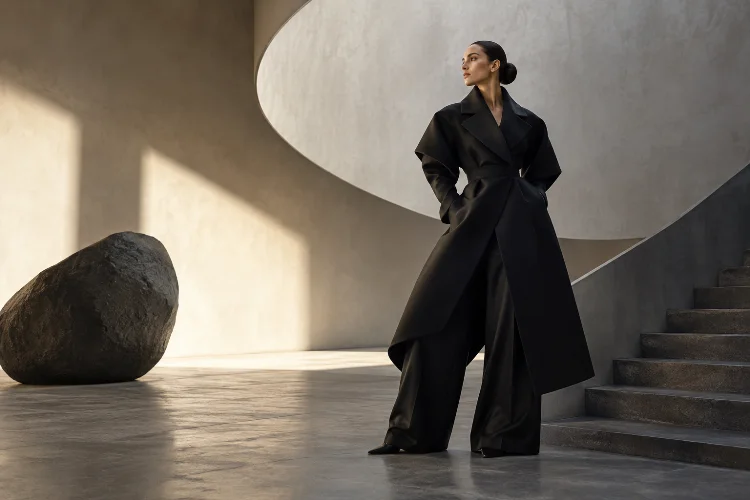
An outfit can be made from beautiful individual pieces and still feel strangely unfinished. The jacket fits, the trousers work, and the shoes are technically appropriate, yet the complete combination lacks the sense of intention that makes great styling look effortless.
The difference often comes down to visual structure.
Advanced outfit construction through shape, line and visual weight treats clothing as a complete composition rather than a collection of separate garments.
Shape establishes the overall silhouette, lines guide the viewer’s eye, and visual weight determines which areas of the outfit feel dominant or quiet.
These ideas are rooted in established fashion-design principles. The Fashion Institute of Technology describes shape and line as fundamental design elements, while balance, proportion, emphasis, and rhythm help organize those elements into a harmonious whole.
You do not need professional design training to apply them. Once you start seeing outfits structurally, small adjustments in length, volume, footwear, or accessories can make familiar clothes look significantly more intentional.
Start With Shape Before Thinking About Details
Shape is the outline an outfit creates when viewed from a distance.
Before anyone notices your watch, stitching, jewelry, or fabric texture, they usually register the overall silhouette. FIT similarly identifies shape or silhouette as one of the first impressions created by a garment.
Think of common silhouettes: narrow on top and wide below, oversized throughout, fitted through the torso with a full skirt, or long and column-like.
Each creates a different visual message.
For example, wide-leg trousers paired with a compact knit produce a clear contrast between a narrow upper section and a broad lower section. Replace that knit with an oversized blazer and the silhouette becomes larger and more architectural.
Neither version is automatically better. What matters is whether the shapes relate intentionally.
When an outfit feels awkward, look at its outline before changing colors or accessories. Often the problem is structural rather than decorative.
Use Line to Direct the Eye
Lines exist everywhere in clothing.
Lapels create diagonals. Trouser creases form vertical lines. Belts establish horizontals. Open coats create two long vertical columns, while cropped jackets introduce a strong break across the torso.
FIT defines line in fashion as the direction of visual interest created by features such as seams, pleats, openings, trims, and construction details.
Understanding these lines gives you more control over how an outfit is read.
Long vertical elements tend to encourage the eye to move up and down. A monochromatic trouser-and-shoe combination can reinforce that continuity.
Horizontal lines interrupt it.
A contrasting belt, visible waistband, cropped sweater, or strong color change can divide the silhouette into distinct sections.
The useful question is not whether vertical lines are “good” and horizontal lines are “bad.” It is whether the direction supports your desired composition.
Fashion becomes more interesting when lines are tools rather than rules.
Control Visual Weight Across the Outfit
Visual weight describes how much attention an object appears to occupy.
A chunky black platform boot carries more visual weight than a delicate beige sandal. A structured leather jacket usually feels heavier than a sheer cardigan. A huge tote creates more presence than a small shoulder bag.
FIT’s design framework describes balance as the distribution of visual weight within a composition.
This becomes extremely useful when styling.
Imagine an oversized dark blazer worn with lightweight pale trousers and tiny shoes. The top may dominate the composition so strongly that the bottom feels disconnected.
Changing to a more substantial shoe could restore balance without changing the clothing.
The opposite can also happen. Very wide trousers paired with a tiny tank might benefit from stronger earrings, a structured bag, or a more defined shoulder line.
Balance does not require symmetry.
An asymmetrical outfit can look perfectly controlled when different areas carry comparable visual significance.
Let One Shape Become the Architectural Anchor
Strong outfits often have one dominant structural idea.
Perhaps it is an oversized coat. Maybe it is dramatically wide trousers, a sculptural skirt, or a sharply cropped jacket.
Once you identify that anchor, other pieces can respond to it.
If extremely wide trousers are the dominant shape, a compact upper layer can emphasize their width. A long fitted coat might instead streamline them, while an oversized jacket exaggerates the volume deliberately.
All three approaches can work.
Problems arise when every garment introduces a completely unrelated silhouette.
This is especially important when layering. Vogue’s examination of complex layered looks shows how designers maintain coherence by controlling proportions, palette, and the relationship between multiple visible layers.
Instead of asking whether every piece is individually interesting, ask whether it supports the main structural idea.
That single question can simplify difficult outfits quickly.
Build Rhythm Through Repeated Lines and Shapes
Repetition helps separate intentional styling from random combination.
A square-neck top can relate to a rectangular bag. Pointed shoes can echo sharp jacket lapels. Rounded sunglasses can connect subtly with a curved handbag.
These small relationships create rhythm.
FIT describes rhythm as guiding the eye through a composition through repetition of elements such as pattern or color.
The repetition does not need to be obvious.
Imagine a tailored outfit containing straight trousers, a rectangular clutch, narrow sunglasses, and pointed shoes. None of those items match exactly, but they share a geometric language.
A softer outfit might combine draped fabric, rounded shoulders, curved jewelry, and slouchy accessories.
This is why two garments that seem unrelated in color can still feel surprisingly harmonious.
Their shapes may be speaking the same visual language.
Use Texture to Redistribute Visual Weight
Texture affects weight even when color stays unchanged.
Glossy leather attracts more attention than matte cotton. Thick cable knit feels visually heavier than fine jersey. Sequins reflect light aggressively, while brushed wool absorbs it more softly.
This makes texture particularly powerful in monochromatic outfits.
Vogue’s guidance on all-black dressing notes that combining materials such as leather, satin, wool, and other contrasting textures prevents a single-color outfit from appearing flat.
Suppose you wear black trousers, a black sweater, and black shoes.
If every material has the same matte finish, the outfit may merge into one visual block. Replace the shoes with polished leather and add a textured coat, and suddenly different areas gain hierarchy.
Texture therefore allows you to adjust visual weight without adding more color.
When one garment already has a dramatic surface – sequins, fringe, heavy embroidery, patent leather – keep some surrounding textures quieter.
Contrast is useful. Competition is harder to control.
Treat Accessories as Structural Components
Accessories are not merely decorations added after the outfit is finished.
They can alter the architecture dramatically.
A wide belt creates a horizontal division and can visually shorten an upper layer. A long pendant introduces a vertical line. Oversized earrings pull attention toward the head, while heavy shoes increase visual weight near the ground.
Bags matter too.
A large tote placed near the hip can make that section of the outfit feel substantially heavier. A tiny bag almost disappears by comparison.
Harper’s Bazaar’s accessory guidance similarly emphasizes allowing strong accessories enough space rather than stacking multiple competing statement pieces.
If your clothing already creates several dramatic shapes, simpler accessories may protect the structure.
If the clothing is minimal, accessories can become the primary architectural feature.
Think of them as punctuation rather than an afterthought.
Use Color Placement to Reinforce Structure
Color does more than create a palette. It divides visual space.
A bright jacket over dark trousers makes the upper body dominant. Bright shoes beneath a neutral outfit pull attention downward.
Color blocking creates even stronger boundaries.
Meanwhile, using similar colors across several garments can reduce visible divisions and emphasize the overall silhouette instead.
Vogue’s recent black-and-white styling coverage demonstrates how a limited palette can still support varied shapes, layers, and accessories while maintaining a cohesive visual foundation.
Monochrome dressing works similarly.
When color differences disappear, shape and texture become much easier to notice. Vogue’s monochromatic styling examples show how changes in fabric density and silhouette keep single-color outfits visually interesting.
Use color strategically rather than simply asking whether two shades match.
Placement can be just as important as hue.
Simplify One Variable When Another Becomes Complex
A useful advanced styling principle is controlled complexity.
If your silhouette is extremely complicated, simplify the color palette.
If you are using strong color blocking, the shapes can become cleaner.
If the outfit contains several textures, you may need fewer statement accessories.
This prevents every visual element from demanding attention simultaneously.
Consider an outfit with a heavily textured coat, wide trousers, patterned knitwear, oversized jewelry, bright shoes, and an architectural handbag.
Each item may be great.
Together, they require a very strong organizing system to avoid looking accidental.
Removing just one or two competing elements can improve clarity dramatically.
Cohesive styling is not necessarily about minimalism. It is about hierarchy.
Evaluate the Outfit From a Distance
One of the easiest styling techniques requires no new clothing.
Step away from the mirror.
At close range, you notice details. From several steps away, you see architecture.
Look at the silhouette first. Then notice where the eye stops, where the largest shapes sit, and whether visual weight feels concentrated too strongly in one area.
Take a quick full-body photograph as well.
Photographs flatten three-dimensional clothing into a simpler composition, which often makes proportion and imbalance easier to identify.
You might discover that rolling a sleeve exposes enough skin to lighten an oversized jacket, or that changing from delicate shoes to chunkier footwear gives wide trousers a stronger foundation.
These are tiny changes with significant structural effects.
Advanced outfit construction is often less about adding something new and more about reorganizing what is already there.
Advanced outfit construction becomes much easier once you start seeing clothing through shape, line, and visual weight.
Shape establishes the silhouette, line determines how the eye travels, and visual weight controls which elements dominate the composition.
Texture, color, accessories, and layering then reinforce – or disrupt – that structure.
The goal is not perfect balance or strict styling formulas. An outfit can be intentionally oversized, asymmetrical, dramatic, or minimal and still feel cohesive when its visual relationships are clear.
The next time an outfit feels slightly wrong, avoid changing everything at once. Identify the dominant shape, follow the major lines, and check where the visual weight sits.
One small adjustment can turn a collection of seperate pieces into a much more consistant and intentional look.