
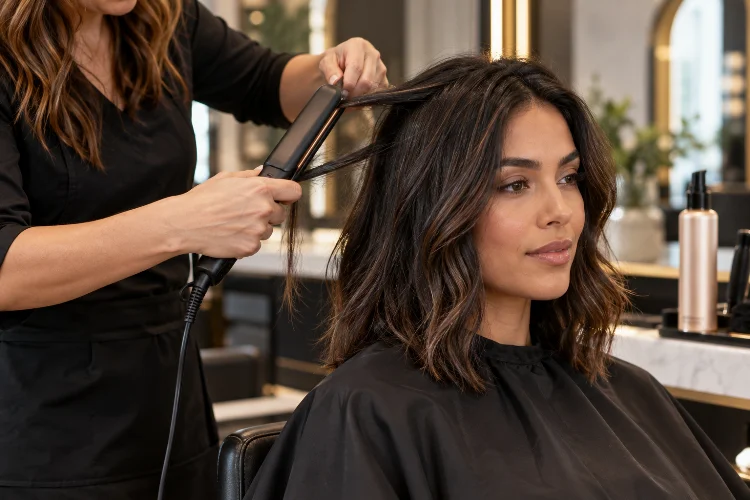
Hair can look perfectly healthy and still behave strangely under heat. A section may refuse to hold a curl, stretch excessively when wet, snap during brushing, or become noticeably rougher after only a few passes with a flat iron.
Those reactions often involve the mechanical condition of the hair fiber.
Elasticity describes the ability of hair to stretch under force and respond without immediately breaking. It is influenced by the cortex, keratin structure, chemical bonds, moisture level, previous processing, and accumulated damage.
The cortex makes up most of the hair fiber and plays a major role in intrinsic strength and elasticity.
Understanding advanced hair elasticity analysis for safer heat styling helps you move beyond universal temperature recommendations. Hair that is bleached, weakened, unusually stretchy, or brittle may need a very different approach from relatively intact virgin hair.
The goal is not to make hair indestructible. It is to recognize its current mechanical limits and style within them.
Understand What Hair Elasticity Actually Means
Hair is mainly composed of keratin proteins organized into complex structures within the cuticle and cortex.
The cortex contributes heavily to mechanical strength. Its protein structures are stabilized by several types of chemical interactions, including hydrogen, ionic, and disulfide bonds.
These structures help hair tolerate bending and stretching during normal grooming and styling.
Healthy elasticity does not mean hair should stretch endlessly.
Instead, the fiber should tolerate reasonable mechanical stress without immediately snapping or remaining permanently distorted. When structural damage becomes significant, that balance can change.
Hair may become excessively stretchy when wet, unusually stiff, or brittle enough to break under relatively small forces.
That is why elasticity should always be considered together with strength. A strand that stretches dramatically but cannot recover is not necessarily healthier than one that stretches very little.
Chemical Processing Can Change Elasticity Before Heat Styling Begins
Heat styling rarely acts on completely untouched hair.
Coloring, bleaching, perming, relaxing, and chemical straightening can modify the cuticle and cortex before a flat iron ever touches the strand.
Reviews of chemical treatments describe damage to cell membrane complexes, cuticle structures, and internal proteins when these processes are intensive or repeatedly performed.
Bleached hair deserves particular caution.
Oxidative processing can weaken structural components and increase porosity, leaving the fiber less resistant to additional mechanical or thermal stress.
This means two people using the same straightener at the same temperature may not experience the same outcome.
Virgin, relatively resilient hair may tolerate a styling session that significantly worsens already-processed ends.
When evaluating elasticity, always consider chemical history before deciding how much heat seems appropriate.
Learn to Recognize Low-Resilience Hair
You do not need laboratory equipment to notice that hair is becoming mechanically compromised.
Watch how it behaves during washing, detangling, drying, and styling.
Hair that suddenly breaks more easily, develops numerous short snapped fibers, feels mushy when wet, tangles excessively, or becomes rough after drying may be signaling structural deterioration.
A simple stretch observation can offer clues, but it should not be treated as a scientific diagnostic test. Individual strands naturally vary in diameter, curl pattern, moisture, and previous damage.
The better approach is looking for repeated patterns across multiple wash days.
If previously strong hair begins stretching excessively when wet and then snapping during detangling, reduce aggressive styling before trying to “test” it further.
Similarly, dry hair that breaks with minimal bending deserves gentler handling.
Elasticity analysis should prevent damage, not become another source of it.
Moisture Changes the Mechanical Behavior of Hair
Hair behaves differently when wet.
Water penetrates the fiber and changes interactions within keratin structures, which is one reason wet hair often feels more flexible than dry hair.
That extra flexibility does not mean wet hair is automatically stronger.
The American Academy of Dermatology notes that wet hair can break more easily during combing or brushing for many hair types and recommends minimizing unnecessary handling.
Tightly curled or textured hair may be an exception in practice, as detangling while conditioned and wet can reduce breakage.
This distinction becomes important before heat styling.
Flat irons should generally be used on dry hair unless a tool is specifically engineered and validated for another method. Applying extreme heat to ordinary wet hair can expose the fiber to rapid thermal and moisture changes.
Dryness presents another problem.
A severely dehydrated, rough fiber can experience increased friction during brushing and sectioning. Conditioning therefore supports safer styling indirectly by improving lubrication and manageability.
Match Heat Level to Hair Condition, Not Ego
Higher temperature does not automatically produce a more professional result.
The safest useful temperature is generally the lowest setting that creates the desired shape efficiently.
The AAD recommends using flat irons on dry hair at low or medium settings and limiting excessive heat exposure. For curling irons, it advises keeping contact brief rather than leaving the tool clamped onto one section for extended periods.
Hair condition should influence how conservative you become.
Fine, bleached, fragile, or visibly weathered hair usually deserves lower thermal exposure. Coarser hair may sometimes require different technique or slightly more heat to reshape effectively, but diameter alone does not guarantee heat resistance.
Chemical history can outweigh natural thickness.
A coarse strand that has been repeatedly lightened may be less mechanically reliable than untreated fine hair.
Use the hair’s current condition as the reference point rather than assuming that “thick hair needs maximum heat.”
Reduce the Number of Passes, Not Just the Temperature
Heat exposure is cumulative.
Using moderate temperature but repeatedly running a flat iron over the same section can still expose the fiber to substantial thermal stress.
Recent experimental work examining heat-damaged hair has shown structural changes including lifted cuticles after repeated thermal exposure.
Better preparation can reduce the need for repeat passes.
Detangle the hair first, create clean sections, and avoid placing too much hair between the plates at once. A section that is too thick may heat unevenly, encouraging you to go over it again and again.
Move the tool smoothly and intentionally.
For curling irons, use a section size that allows the heat to reach the hair evenly without requiring long contact.
An effecient single pass is often preferable to repeatedly correcting the same piece.
Use Conditioning to Reduce Mechanical Stress
Conditioner does not turn damaged hair back into virgin hair, but it can make styling safer.
Conditioning ingredients can reduce friction, improve detangling, increase smoothness, and help the cuticle surface behave more predictably.
Reviews of hair cosmetics describe conditioners as useful for improving manageability and minimizing forces that contribute to breakage.
Leave-in conditioner can also be helpful for hair that is color-treated, permed, dry, tangled, or regularly heat styled.
The AAD notes that some leave-in conditioners are specifically formulated to provide heat protection, with that function normally indicated on the product packaging.
That does not mean more conditioner is always better.
Fine hair can become overloaded by heavy products, while coarse or highly weathered hair may tolerate richer formulations.
Apply enough to improve slip and reduce friction without making the hair so coated that styling becomes difficult.
Understand What Heat Protectants Can and Cannot Do
A heat protectant is useful, but it is not permission to ignore temperature.
Heat-protective formulations can help create a film over the fiber, improve lubrication, and modify how the hair responds during thermal styling. Different formulas use combinations of silicones, conditioning polymers, proteins, and other film-forming ingredients.
Their protection is not unlimited.
No spray can make repeated maximum-temperature ironing harmless.
Think of heat protectant like a seat belt rather than an invincibility shield. It lowers risk when used correctly, but safer driving still matters.
Apply it evenly enough that the sections receiving heat are actually covered, and follow the product instructions.
Then combine it with sensible temperature, clean sectioning, shorter contact time, and fewer passes.
Heat safety works best as a system.
Give Compromised Hair Recovery Time
Mechanical performance can deteriorate when heat styling is combined with bleaching, coloring, chemical straightening, aggressive brushing, and frequent high-tension hairstyles.
The hair shaft is not living tissue once it emerges from the scalp. Severe structural damage cannot biologically heal itself.
Cosmetic treatments can temporarily improve smoothness, lubrication, appearance, and manageability, but preventing additional deterioration remains important.
If elasticity seems poor, reduce thermal frequency rather than simply changing products.
The AAD recommends partially air-drying hair when practical and decreasing the number of weekly blow-drying sessions to limit damage.
A temporary break from irons can also make it easier to assess whether breakage is improving.
During that period, concentrate on conditioning, gentle detangling, reduced friction, and avoiding unnecessarily tight hairstyles.
Recovery is partly about stopping the damage from accumulating.
Adjust Your Strategy Along Different Parts of the Hair
One head of hair can contain multiple mechanical conditions.
New growth near the scalp may be relatively intact. Mid-lengths might have gone through several color treatments, while the ends may have years of accumulated heat, sunlight, brushing, and chemical exposure.
Using one temperature from root to tip ignores those differences.
Older ends often need fewer passes and more conservative heat because they have experienced more weathering.
You can also adjust product placement.
Apply richer conditioning or more protective leave-in product to damaged lengths while keeping products lighter near healthy roots when necessary.
This zoned strategy is especially useful for long or highlighted hair.
Do not assume the strongest-looking area represents the entire strand.
Heat styling should follow the most vulnerable sections, not just the healthiest ones.
Know When Breakage Is More Than a Styling Issue
Not every change in hair behavior comes from heat damage.
Persistent breakage, sudden thinning, unusual shedding, scalp inflammation, or dramatically different hair texture can have other causes.
The AAD advises seeking professional evaluation when hair loss or hair-health concerns persist because appropriate treatment depends on identifying the underlying problem.
This is especially important if density is visibly decreasing rather than strands simply breaking at the ends.
Cosmetic changes can improve how hair feels, but they cannot diagnose medical hair loss.
Recognizing that boundary is part of advanced hair analysis.
Hair elasticity offers useful clues about how safely a fiber can tolerate heat, tension, and repeated reshaping. Healthy styling is not about finding the hottest temperature your hair can survive. It is about achieving the desired shape with the least unnecessary stress.
Chemical processing, moisture state, cuticle condition, previous breakage, and the integrity of the cortex all influence how hair behaves under heat.
Before your next styling session, examine how the hair feels when wet and dry, especially through older or chemically processed sections.
Then lower the temperature where necessary, improve conditioning, use heat protection, and reduce repeated passes. Small adjustments in technique can preserve elasticity, reduce breakage, and keep styling results more consistant over time.