
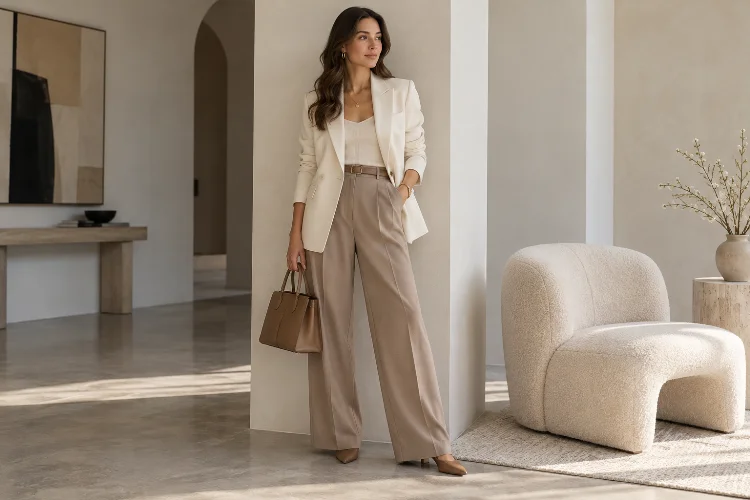
Sometimes every individual piece in an outfit looks good, yet the complete look still feels slightly wrong.
The blazer is stylish, the trousers fit well, the shoes are interesting, and the bag works perfectly on its own – but somehow they do not feel like they belong together.
That is where style architecture becomes useful.
Rather than treating dressing as a collection of separate purchases, advanced style architecture for building more cohesive outfits looks at an outfit as one visual composition.
Silhouette, proportion, colour, texture, visual weight, repetition, focal points, and accessories all influence how the eye reads the finished look.
Fashion design principles use similar ideas. The Fashion Institute of Technology describes balance, proportion, emphasis, and rhythm as fundamental principles for combining design elements successfully.
You do not need to dress minimally or follow strict fashion rules to use these concepts. A maximalist outfit can be just as cohesive as a simple monochrome look. What matters is creating enough visual relationships between the pieces that the outfit feels intentional.
Start With the Overall Silhouette Before Individual Pieces
A cohesive outfit begins with shape.
Before worrying about jewellery or the exact shade of your shoes, look at the outline created by the clothing. Is the upper half fitted while the lower half is wide? Are both halves oversized? Does a cropped jacket create a clear waistline, or does a long coat produce one continuous vertical shape?
FIT describes proportion as the relationship between different parts of a design and emphasizes that those elements should work within the scale of the complete composition.
That principle translates easily into everyday styling.
Wide-leg trousers paired with an oversized sweater can work beautifully, but the outfit may need a deliberate structural element such as a visible waistband, shorter jacket, pointed shoe, or defined shoulder to prevent the volume from feeling accidental.
Conversely, combining a fitted top with relaxed trousers creates an immediate contrast between narrow and broad shapes.
The goal is not always to “balance” oversized clothing with something tight. Vogue’s recent coverage of runway layering shows that consistent oversized proportions can also feel polished when the silhouette is clearly intentional.
Think about the complete outline first. Individual pieces become easier to choose afterward.
Use Proportion to Control Where the Eye Travels
Proportion determines how an outfit is divided visually.
A jacket ending exactly at the widest point of a skirt can create a very different effect from one ending at the waist. Likewise, a long shirt underneath a short jacket introduces multiple horizontal breaks.
None of these arrangements are inherently wrong.
The question is whether the divisions support the silhouette you want.
Vogue has highlighted proportion as a central styling device in contemporary fashion, including combinations of romantic tops with structured trousers and intentional contrasts between cropped, elongated, and relaxed pieces.
One useful approach is to identify the dominant proportion first.
If wide trousers are the architectural foundation of the outfit, let other pieces respond to them. You might choose a compact knit, fitted tank, cropped blazer, or long streamlined coat rather than introducing several unrelated volumes.
You can break that logic deliberately, but doing it intentionally makes the difference.
A successful outfit often has one proportion that leads and several smaller decisions that support it.
Build a Controlled Colour Story
Colour is one of the fastest ways to create cohesion because repeated hues establish an immediate visual relationship.
That does not mean everything needs to match exactly.
Imagine dark brown trousers, an ivory shirt, burgundy shoes, and a bag containing both brown and burgundy. The repeated warm tones allow the pieces to communicate even though they come from different colour families.
Monochromatic outfits use this principle in its most obvious form. Vogue’s coverage of tonal dressing notes that committing to one colour story can create a strong sense of cohesion even when silhouettes and textures vary.
You can apply the same idea more subtly.
Choose one dominant neutral, one supporting colour, and perhaps one smaller accent. For example, navy could appear in trousers and a jacket, pale blue in the shirt, and red only in the shoes.
Current colour-blocking approaches also show that contrast tends to look more controlled when one hue acts as the visual anchor rather than several equally loud colours competing at once.
The goal is not matching. It is creating relationships.
Repeat Elements to Create Visual Rhythm
Good outfits often contain small repetitions that are not immediately obvious.
A silver belt buckle may connect with earrings. A curved handbag may echo the rounded toe of a shoe. Brown sunglasses can repeat the colour of a leather belt.
Fashion design calls this rhythm.
FIT defines rhythm as a way of leading the eye through a design using repetition of elements such as pattern or colour.
Repetition makes an outfit feel designed rather than assembled randomly.
You can repeat shape, colour, material, line, or even mood.
For example, a sharp blazer, rectangular bag, pointed shoes, and geometric earrings share a structural language even if none of them match.
A softer outfit may use a draped blouse, curved trousers, slouchy bag, and rounded jewellery instead.
You do not need every element to repeat. Two or three related details are usually enough to create rhythm without making the outfit look overly coordinated.
Balance Visual Weight Across the Outfit
Visual weight describes how much attention an element seems to occupy.
A chunky black boot carries more visual weight than a thin nude sandal. A large leather jacket feels heavier than a semi-sheer cardigan. A dramatic necklace commands more attention than a delicate chain.
This is different from the actual physical weight of clothing.
FIT describes balance as the distribution of visual weight within a design, including both symmetrical and asymmetrical approaches.
Suppose you wear an oversized black jacket with very lightweight pale trousers and tiny shoes. The upper half may dominate so strongly that the lower half feels disconnected.
Adding a more substantial shoe could restore balance.
The opposite can happen with very wide trousers and a tiny top. A stronger shoulder, larger bag, or noticeable necklace may give the upper body enough presence to communicate with the lower silhouette.
Balance does not require equal size everywhere.
It simply means no part of the outfit feels unintentionally disconnected from everything around it.
Use Texture to Add Depth Without Creating Chaos
Texture becomes especially useful when working with a limited colour palette.
A head-to-toe neutral outfit could include wool, leather, silk, denim, and knitwear. Even if the colours are almost identical, differences in surface finish keep the composition interesting.
Vogue’s minimalist styling guidance emphasizes both fabric quality and texture as ways to make restrained wardrobes feel richer rather than boring.
Contrast usually works best when it has a purpose.
A soft cashmere sweater over glossy leather trousers creates an obvious tactile contrast. A crisp cotton shirt with brushed wool trousers feels sophisticated because the textures are different without fighting each other.
Problems begin when every element asks for attention.
Sequins, distressed denim, patent leather, heavy embroidery, animal print, and fuzzy knitwear can technically coexist, but building coherence becomes harder when there is no hierarchy.
If one texture is dramatic, allow others to become quieter.
That simple adjustment often creates more cohesivness than removing interesting pieces entirely.
Establish One Clear Focal Point
Every strong outfit does not require a statement piece, but most benefit from a clear visual hierarchy.
The Fashion Institute of Technology describes emphasis as creating a center of interest while other elements support it.
Your focal point might be a sculptural coat, unusual shoes, a bright bag, patterned trousers, or simply a sharply tailored silhouette.
Once you identify it, make the other decisions around that feature.
If an embroidered jacket is the hero, highly embellished trousers, oversized jewellery, dramatic boots, and a contrasting bag may all compete for the same attention.
Harper’s Bazaar similarly recommends treating highly embellished clothing almost like jewellery and keeping surrounding pieces more restrained when the statement item is already visually strong.
This does not mean the rest of the outfit needs to be boring.
Support can come through related colours, simpler shapes, repeated textures, or details that echo the focal piece without challenging it.
Hierarchy creates clarity.
Treat Accessories as Part of the Architecture
Accessories should not always be the last-minute decoration added after an outfit is finished.
Shoes, belts, bags, eyewear, scarves, and jewellery can change the proportion and visual weight of the entire composition.
A wide belt creates a strong horizontal division. A long necklace reinforces vertical movement. Large earrings pull attention upward, while a bulky shoe gives more weight to the bottom of the outfit.
Vogue’s minimalist-fashion guidance notes that accessories can provide both personality and texture even within otherwise restrained wardrobes.
The key is deciding their function.
If the clothing is architecturally complex, simpler accessories may protect the silhouette. If the base consists of jeans, a plain shirt, and a simple coat, accessories can carry much more of the visual interest.
Avoid treating every accessory as a seperate statement.
If the bag is oversized, the earrings dramatic, the belt heavily decorated, and the shoes brightly coloured, ask whether they are telling the same story.
Sometimes removing one item improves the outfit more than adding another.
Layer With a Clear Structural Logic
Layering becomes difficult when every layer introduces a completely new length, colour, or volume.
More pieces create more relationships to manage.
An easier approach is to choose one organising principle. It could be a consistent colour palette, repeated hem lengths, progressively longer layers, or one dominant silhouette.
Vogue’s guide to layered styling illustrates how consistent proportions and unified colour families can keep complex combinations visually controlled.
For example, a white shirt under a gray sweater with a charcoal coat works because the colour progression is simple even though three layers are visible.
Alternatively, you could combine contrasting colours but keep the shapes very consistant.
The more complicated one styling variable becomes, the simpler another can be.
That relationship is one of the most useful principles in advanced styling.
Edit the Outfit From a Distance
Outfits are usually built up close, but they should also be evaluated from several steps away.
At a distance, tiny details disappear and the overall architecture becomes clearer.
Look at silhouette first. Then examine the distribution of dark and light areas, the location of the focal point, and whether any single item feels unexpectedly dominant.
Try temporarily removing one accessory.
Roll a sleeve, change the tuck, alter the trouser break, or swap a heavy shoe for something lighter. Small proportional adjustments can change the complete composition without requiring an entirely different wardrobe.
Fashion styling is rarely about finding mathematically perfect proportions.
It is about creating enough visual logic that the viewer understands the outfit as one idea.
Once that architecture works, personality can sit on top of it much more freely.
Advanced style architecture turns outfit building into a process of relationships rather than a search for individually perfect pieces.
Silhouette establishes the overall structure, proportion controls visual divisions, colour and repetition create rhythm, while texture and accessories add depth.
Visual weight and focal points then determine where attention travels.
The goal is not perfect symmetry or rigid coordination. Cohesive outfits can be minimal, maximal, tailored, relaxed, monochromatic, or highly colourful. They simply need a recognisable internal logic.
The next time an outfit feels slightly “off,” resist replacing everything. Step back and identify which architectural relationship is missing.
Adjusting one proportion, repeating one colour, or removing one competing focal point may be enough to make the entire look feel intentonal and complete.