
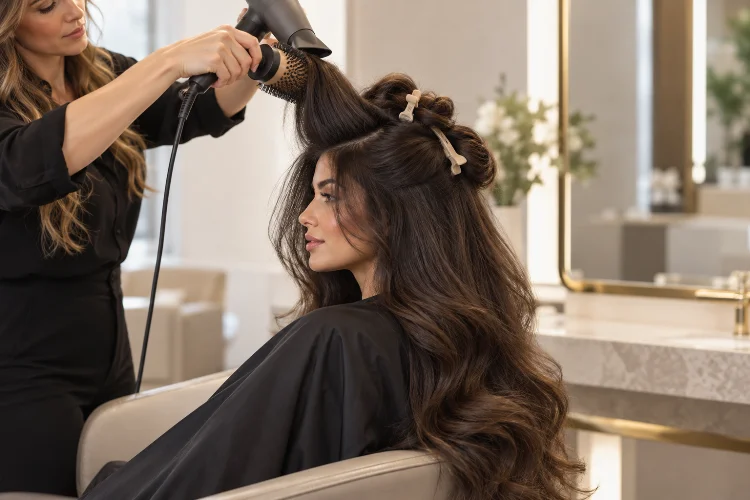
Two people can have the same curl pattern, similar hair length, and even similar strand thickness, yet the same hairstyle can look completely different on each of them. Hair density is often the missing variable.
Hair density describes how many individual hair fibers grow within a given area of the scalp. It is different from strand diameter, which describes whether each individual fiber is fine, medium, or coarse.
Research also shows that density naturally varies between scalp regions, individuals, age groups, and populations. Understanding advanced styling strategies for different hair density levels makes styling much more predictable.
Lower-density hair often benefits from techniques that preserve visible fullness, while higher-density hair may require strategic weight removal, stronger sectioning, and better product distribution.
The objective is not to make every head of hair look equally thick. Good styling works with the amount of hair you actually have, creating balance, movement, volume, and control without unnecessary heat, tension, or product buildup.
Understand Hair Density Before Choosing a Styling Strategy
Hair density and hair thickness are frequently confused.
You can have very fine individual strands but a large number of them, creating high-density hair. Someone else may have thick, coarse strands but fewer follicles producing visible hairs, creating lower overall density.
Scientific studies confirm that density can vary considerably across different scalp regions and populations. One study of healthy Thai adults, for example, found meaningful differences between scalp sites and a decline in average density with increasing age.
This distinction changes styling decisions.
High-density fine hair may become weighed down because thousands of lightweight strands are packed together. Low-density coarse hair may look visually fuller than expected because each individual strand occupies more space.
Before labeling your hair “thin” or “thick,” consider both strand diameter and how much scalp is naturally visible when the hair is parted.
Style Low-Density Hair Around Visual Fullness
Lower-density hair generally benefits from preserving movement and avoiding anything that separates the strands too dramatically.
Heavy oils, dense butters, and multiple layers of styling cream can encourage hair to clump together. While that may produce shine, it can also make more scalp visible and reduce the impression of fullness.
Lightweight products are often more useful.
A volumizing mousse, root spray, lightweight leave-in, or flexible-hold styling product can provide shape without collapsing the roots. Apply most conditioning products toward the mid-lengths and ends if the scalp area becomes flat easily.
Drying direction can create additional lift.
Instead of blow-drying everything downward from the beginning, lift sections away from their natural resting position. Changing the part after the hair has dried can also create temporary root volume because the hair is being redirected against its usual pattern.
The aim is not enormous artificial height. Small amounts of strategic elevation can make lower-density hair look noticeably fuller.
Use Haircut Shape to Support Lower Density
A haircut can influence apparent density almost as much as styling products.
Excessive layering can sometimes make low-density hair look even thinner because too much material is removed from the lower sections. The ends may appear wispy even when the scalp area still looks relatively full.
Blunter shapes often preserve visual weight.
That does not mean all low-density hair needs a perfectly straight blunt cut. Soft internal shaping or carefully placed face-framing sections can create movement without sacrificing too much mass.
Length also matters.
Very long hair can sometimes emphasize lower density because the weight pulls the roots flatter while older ends gradually become thinner through weathering and breakage.
A shoulder-length or medium cut may create a stronger silhouette for some people simply because the ends appear denser.
The best shape depends on curl pattern and strand diameter, so density should be one factor rather than the only factor considered.
Medium-Density Hair Offers More Styling Flexibility
Medium-density hair often has the widest styling range because there is enough hair to create fullness without automatically producing excessive bulk.
This makes experimentation easier.
You can usually create sleek styles, waves, curls, layered cuts, ponytails, or volume-focused blowouts without radically changing the routine.
Product selection can also be more flexible. Creams, mousses, gels, or lightweight oils may all work depending on texture and porosity.
However, medium density should not be treated as a guarantee that every product will work.
Fine medium-density hair may still collapse under rich creams, while coarse medium-density curls may need substantially more conditioning and hold.
Think of density as one coordinate in a larger hair profile. Porosity, fiber diameter, natural pattern, chemical processing, and environmental humidity still influence how the final style behaves.
The advantage is simply that medium density tends to give you more room to adjust either toward volume or toward control.
High-Density Hair Needs Distribution More Than Extra Product
When hair density is high, styling difficulties often come from distribution rather than a lack of product.
Applying one large handful of styling cream to the outer surface may leave the top coated while inner sections receive almost nothing.
Sectioning becomes essential.
Divide the hair into manageable areas before adding leave-in conditioner, curl cream, gel, or heat protectant. Smaller sections help distribute product more evenly and make it easier to control the roots.
This is especially useful with dense curly or coily hair, where outer layers can hide large amounts of hair underneath.
More density does not automatically mean you need more of every product, though.
Start with moderate amounts and increase only when the strands genuinely require it. Excess product trapped throughout dense hair can extend drying time, create buildup, and reduce natural movement.
Efficient distribution usually matters more than simply increasing quantity.
Reduce Bulk Strategically in High-Density Hair
High-density hair can look impressive but may become difficult to shape when too much volume accumulates in one area.
Strategic layering can redistribute that mass.
For straight or wavy hair, internal layers may prevent the silhouette from becoming excessively triangular or heavy at the bottom. Curly hair can benefit from shaping that allows different curl groups to sit naturally without creating unwanted bulk.
The goal is controlled weight removal, not random thinning.
Aggressive use of thinning shears can create unwanted short fibers, frizz, or uneven regrowth in some textures. Haircut technique should consider both density and natural pattern.
Styling can accomplish some of the same visual balancing.
If you want less width, direct airflow downward and choose smoothing products that encourage strands to stay closer together. If you want to celebrate the density instead, root-lifting techniques and diffusing can create a larger, more dimensional silhouette.
Density is not a problem to fix. It is a structural characteristic to shape intentionally.
Adjust Drying Technique to Density
Hair density has a major impact on drying time.
High-density hair contains more individual fibers holding water after washing, so the inner layers may remain damp long after the surface feels dry.
This matters when using heat.
The American Academy of Dermatology recommends allowing hair to partially air-dry when possible and reducing unnecessary blow-drying to limit damage. It also recommends using heated tools conservatively because excessive heat can damage any hair type.
For dense hair, begin by removing excess water gently with a microfiber towel or similar low-friction method. Then section the hair so airflow reaches the interior rather than repeatedly overheating the outer layers.
Low-density hair usually dries much faster.
That makes it easy to accidentally continue blow-drying after the strands are already dry. Use enough heat to establish the shape, then stop rather than chasing additional smoothness with repeated passes.
Efficient drying improves both styling and long-term fibre condition.
Match Root Styling to Density Level
Roots strongly influence how dense the finished hairstyle appears.
For low-density hair, concentrate volumizing products close to the roots while keeping heavy oils away from the scalp. Blow-drying upward or briefly changing the part can create more visible lift.
Medium-density hair can usually move between root volume and sleekness relatively easily.
High-density hair may require the opposite strategy. If excessive root volume creates a shape you do not want, use controlled tension and downward airflow to encourage a more compact silhouette.
Curly high-density hair can behave differently again.
Diffusing near the roots can increase expansion dramatically, while applying product in larger sections and drying downward can create more elongation.
The important point is that root styling should support the desired silhouette rather than following a universal rule about “more volume.”
Protect Every Density Level From Excessive Tension
Styling decisions also affect scalp and hair health.
Very tight ponytails, extensions, braids, cornrows, or other repeatedly tensioned styles can contribute to breakage and traction-related hair loss. The AAD warns that prolonged tension can eventually lead to permanent hair loss in some cases.
This matters at every density level.
Someone with very dense hair may create extra scalp tension simply because the ponytail itself is heavy. Someone with lower density may repeatedly use extensions or tight styles to create more fullness, potentially placing vulnerable follicles under additional stress.
Rotate styles and avoid interpreting pain as evidence that a hairstyle is secure.
Protective styling should actually protect the hair.
If a hairstyle causes persistent tenderness, bumps, broken hairs around the hairline, or obvious pulling, reducing tension is more sensible than simply tolerating the discomfort.
Do Not Confuse Naturally Low Density With Hair Loss
Some people naturally have lower-density hair and have always had visible scalp through certain areas.
That is different from a noticeable reduction in density.
If your ponytail suddenly feels smaller, the part becomes progressively wider, or previously dense areas begin thinning, styling techniques should not become a substitute for investigating the cause.
Research confirms that normal density varies significantly between people, making your own previous baseline particularly useful.
The AAD also recommends gentle shampooing, regular conditioning, reduced heat, and lower mechanical stress when hair is thinning or falling out because fragile hair can break more easily.
A dramatic or progressive change deserves professional evaluation, particularly when accompanied by patchy loss, scalp symptoms, or substantial shedding.
Good styling can make hair appear fuller, but it cannot diagnose why density has changed.
Build a Routine Around Your Actual Density
The most effective density-based routine does not require dozens of specialized products.
Observe how much scalp is visible, how easily the roots collapse, how long the hair takes to dry, and whether the overall shape feels too sparse, balanced, or excessively bulky.
Then adjust technique.
Low-density hair may benefit from lightweight styling, strategic root lift, and haircuts that preserve visual mass. Medium density generally offers more flexibility. High-density hair usually performs better with thoughtful sectioning, even product distribution, and deliberate control of bulk.
Reevaluate occasionally.
Density can change with age, hair loss, breakage, and other factors, so a routine that worked perfectly several years ago may need adjustment. Research has documented age-related differences in measured scalp hair density as well.
Hair styling becomes much more predictible once the routine follows the hair you currently have rather than the hair you used to have.
Hair density changes much more than how “thick” a hairstyle appears. It influences product weight, root volume, sectioning, drying time, haircut shape, and the amount of control required to create a balanced silhouette.
Low-density hair often benefits from preserving visual fullness and limiting heavy product buildup. Medium density offers greater styling flexibility, while high-density hair usually requires better distribution, sectioning, and strategic management of bulk.
Start by separating density from strand thickness and curl pattern. Then observe how your roots, lengths, and overall shape behave during a normal styling routine.
A few targeted changes – using less product, changing section size, or adjusting drying direction – can produce far better results than completely rebuilding your routine.