
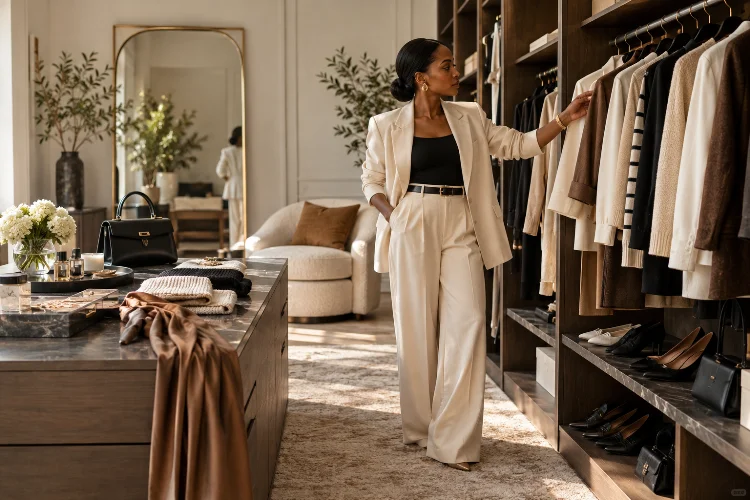
Some people can wear completely different outfits throughout the week and still look unmistakably like themselves.
One day they are in relaxed denim, the next in tailoring, and later in an evening outfit – yet there is always a recognizable visual thread connecting everything.
That consistency rarely comes from owning identical clothes. It comes from having a styling system.
Advanced styling systems for creating consistent personal identity focus on recurring choices: silhouettes you naturally prefer, colors that repeat throughout your wardrobe, familiar proportions, signature accessories, and outfit formulas that make dressing easier.
Vogue has long described signature silhouettes and repeatable wardrobe formulas as important expressions of personal style.
The goal is not to create a rigid fashion uniform. In fact, personal style can evolve constantly. What matters is having enough recurring visual signals that experimentation still feels connected to you.
Once those signals become clear, shopping becomes more selective, styling becomes faster, and your wardrobe begins functioning like one coherent visual language rather than a collection of unrelated purchases.
Identify the Style Codes You Already Repeat
Your personal style probably already contains patterns, even if you have never deliberately defined them.
Look at the outfits you genuinely enjoy wearing rather than the clothes you think you should wear. You may notice repeated elements such as wide trousers, cropped jackets, monochromatic palettes, silver jewelry, loafers, oversized shirts, or structured handbags.
These recurring choices are your style codes.
A style code does not need to be dramatic. Anna Wintour’s bob, necklaces, and recognizable silhouettes are obvious examples, while other people build identity through much quieter repetitions.
Harper’s Bazaar recently explored how fashion uniforms can make personal style immediately legible, even while arguing that people should remain free to change them.
Try identifying three to five characteristics that appear regularly in your favorite outfits.
Those elements become the foundation of a styling system without forcing every look to be identical.
Build Signature Silhouettes Instead of Signature Outfits
Repeating one exact outfit eventually feels restrictive. Repeating a silhouette is much more flexible.
Imagine your preferred formula is a compact top with relaxed trousers and substantial footwear. The actual garments can change completely: fitted knit with denim, cropped jacket with tailored pants, or a tank with flowing trousers.
The underlying proportions remain familiar.
Vogue has previously asked editors to identify signature silhouettes based on the shapes and proportions they repeatedly choose, demonstrating how recognizable style can emerge from consistent structural preferences rather than specific garments.
You might prefer a long-over-long silhouette with a coat over wide pants. Or perhaps your style works around fitted tops, defined waists, and fuller skirts.
Once you identify two or three dependable silhouettes, wardrobe decisions become easier.
You are no longer asking whether an item is attractive in isolation. You are asking whether it fits into a shape you actually enjoy wearing.
Create Repeatable Outfit Formulas
An outfit formula is essentially a template.
For example: tailored trousers + relaxed knit + loafers + structured bag.
Another could be straight jeans + fitted T-shirt + oversized jacket + boots.
These formulas eliminate the need to invent a completely new look every morning. Vogue’s ongoing outfit-formula coverage similarly treats reliable combinations as wardrobe shortcuts that can be recreated with different pieces.
The important part is leaving space for variation.
If your base formula is wide trousers and a button-down shirt, one version could feel minimalist in gray and white. Another might use bright trousers, an embroidered shirt, chunky jewelry, and colored shoes.
Same architecture, different personality.
Start with three formulas covering the situations you encounter most often – perhaps casual days, work, and social occasions.
A strong system should make dressing easier without making it predictable.
Develop a Consistent Color Language
Color can become one of the strongest signals of personal identity.
This does not necessarily mean restricting yourself to three neutral shades forever. Instead, think about which colors repeatedly appear and how you tend to combine them.
Someone might build around black, cream, olive, and burgundy. Another person may consistently use navy and gray but introduce bright green, orange, or red accessories.
Repetition creates familiarity.
Vogue’s discussion of personal fashion formulas and color analysis has highlighted how identifying colors and shapes that work together can make a wardrobe easier to coordinate and potentially reduce unsuccessful purchases.
You can build a core palette while keeping seasonal or experimental colors around it.
For example, if dark brown is one of your recurring neutrals, a bright blue shirt still connects naturally when worn with your familiar brown trousers, shoes, or bag.
Identity comes from the pattern of choices, not from banning unfamiliar colors.
Give Accessories a Recognizable Language
Accessories often create more identity than clothing.
Consider someone who regularly wears narrow sunglasses, silver rings, black leather shoes, and compact structured bags. Those details can make jeans and a white shirt feel personal before any dramatic clothing is involved.
Your accessories can repeat material, scale, shape, or mood.
Maybe your wardobe leans toward rounded bags and soft leather. Perhaps you consistently choose architectural jewelry and angular eyewear. Some people build identity almost entirely through vintage scarves, watches, rings, or unusual shoes.
The advantage is flexibility.
A signature accessory language can connect formal and casual outfits that otherwise have little in common.
You do not need every accessory to repeat every day. Instead, develop a small family of details that feel related.
That continuity is often enough to make a changing wardrobe feel cohesive.
Use One Signature Element as an Anchor
Some personal styles become recognizable because one element appears again and again.
It might be tailoring, colorful socks, wide trousers, vintage bags, graphic T-shirts, strong eyewear, or a particular type of footwear.
The Cut recently profiled several generations of men whose wardrobes used recurring practical or expressive pieces to communicate identity, showing how seemingly ordinary clothing choices can become deeply personal through repetition.
An anchor works particularly well when the rest of your style is eclectic.
Suppose you enjoy romantic dresses, tailoring, denim, and streetwear. A consistent shoe style or jewelry language can connect all four categories.
This is useful because personal identity does not require aesthetic purity.
You can enjoy several fashion influences at once. The anchor simply gives the eye something familiar to recognize.
Edit the Wardrobe Around Compatibility
A consistent style becomes difficult when every purchase belongs to a completely different wardrobe.
One jacket looks great but requires trousers you do not own. A pair of shoes works with only one dress. A trending color clashes with almost everything already in your closet.
This is how wardrobes become large but strangely difficult to use.
Before purchasing something, imagine at least three outfits you could create with pieces you already own.
That does not mean every purchase must be practical or neutral. Statement pieces can be valuable, but they should still have some relationship to your established silhouettes, colors, textures, or accessories.
Vogue’s exploration of personal fashion formulas suggests that understanding what reliably works can help people shop more intentionally and build wardrobes whose pieces coordinate more naturally.
A coherent wardrobe creates more combinations from fewer pieces.
That is a styling advantage as much as an organizational one.
Separate Consistency From Sameness
Consistent style does not mean wearing a uniform every day.
In fact, overly strict rules can eventually make personal style feel artificial.
A useful system should be flexible enough to accommodate different moods, contexts, and phases of life. Harper’s Bazaar recently challenged the idea that sophisticated personal style requires one permanent uniform, arguing that experimentation and changing tastes can be equally authentic.
Think of consistency like handwriting.
You can write different words, use different pens, and change the size of the letters, yet something about the handwriting remains recognisable.
Personal style works similarly.
Perhaps your tailoring becomes looser over time. Your palette becomes brighter. Sneakers replace formal shoes.
As long as several deeper codes remain connected, your identity can evolve without disappearing.
Document Outfits That Actually Work
Memory is surprisingly unreliable when it comes to clothes.
You may remember loving a jacket but forget which trousers made the proportions work.
Take occasional full-body photographs of successful outfits.
After twenty or thirty examples, review them together. Look for recurring proportions, colors, footwear, jewelry, jacket lengths, and combinations.
You may discover that nearly every favorite outfit contains one structured piece. Or that your best looks use two neutral colors plus one accent.
Those observations are more useful than abstract style labels such as “classic,” “minimalist,” or “creative.”
They describe your real behavior.
Create a small personal archive on your phone and use it when shopping or planning outfits. Over time, you are effectively building your own styling reference library.
Leave Controlled Space for Experimentation
A styling system should provide structure, not eliminate surprise.
One useful approach is keeping most of the outfit familiar while changing one major variable.
Wear your usual wide trousers and simple shoes but experiment with a dramatic jacket. Keep your signature monochrome silhouette but introduce a bright bag. Pair your familiar blazer with an unexpected skirt.
This creates controlled experimentation.
The new element receives attention because everything around it already belongs to your visual language.
Current fashion culture increasingly encourages this more individual approach. Harper’s Bazaar’s recent discussion of personal style describes a movement away from rigid algorithm-driven aesthetics toward broader experimentation and personal taste.
A good system therefore becomes a platform for creativity.
It tells you where home is, so you can move away from it intentonally.
A consistent personal identity does not require a wardrobe full of identical clothing. It comes from repeating enough visual ideas – silhouette, proportion, color, accessories, texture, and outfit formulas – that different looks still feel connected.
Start by identifying what you already repeat naturally. Build two or three signature silhouettes, create dependable outfit formulas, and develop a small family of colors and accessories that can move across different situations.
Then keep experimenting.
The strongest personal style systems provide familiarity without becoming restrictive. Review photographs of outfits you genuinely enjoy and identify the patterns behind them.
Once you understand your own visual language, getting dressed becomes faster, shopping becomes more selective, and even unexpected fashion choices can still feel unmistakably yours.