
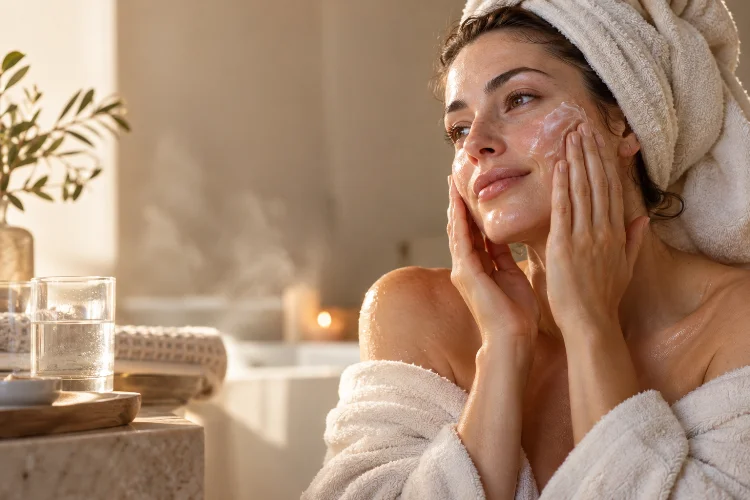
A compromised skin barrier can make even a carefully designed skincare routine feel frustrating. You apply moisturizer, the skin feels comfortable for an hour or two, and then tightness, roughness, flaking, or sensitivity returns.
The problem is often not simply a lack of water. Damaged barrier function can allow water to escape from the outer layers of the skin more easily, a process commonly discussed as transepidermal water loss, or TEWL.
Moisturizers can help by combining ingredients that attract water, smooth the surface, and reduce evaporation.
That is why advanced moisture retention strategies for compromised skin barriers focus on keeping hydration where the skin needs it rather than endlessly adding more watery products.
A successful approach usually combines gentle cleansing, humectants, emollients, occlusives, barrier lipids, and sensible recovery periods. Just as importantly, it reduces habits that repeatedly strip or irritate the skin.
The aim is not temporary softness. It is creating conditions that help the complexion remain comfortable, flexible, and better hydrated throughout the day.
Understand Why Compromised Skin Loses Moisture Faster
The outermost layer of the epidermis, the stratum corneum, acts as an important permeability barrier.
Its cells are surrounded by organized lipids, including ceramides, cholesterol, and free fatty acids. These structures help limit water evaporation while also reducing the penetration of unwanted external substances.
When this barrier becomes disrupted, moisture retention becomes less efficient.
Someone may therefore apply a hydrating serum and initially notice softer skin, only to experience tightness again several hours later. Water was added, but the skin was not sufficiently protected against evaporation.
This distinction matters because “hydrating” and “moisture-locking” products are not always interchangeable.
For compromised skin, the best routine usually addresses both.
Combine Humectants, Emollients, and Occlusives
A moisturizer can perform several different functions depending on its ingredients.
Humectants such as glycerin attract and retain water in the stratum corneum. Emollients help soften rough areas and fill spaces between surface cells, while occlusive ingredients form a more water-resistant layer that reduces evaporation.
This explains why simply layering several hyaluronic acid or glycerin serums may not solve persistent dehydration.
If water continues evaporating rapidly, an emollient or occlusive layer may be necessary afterward.
Petrolatum, mineral oil, paraffin, and dimethicone are common examples of ingredients with occlusive properties. Heavier ointments generally reduce evaporation more effectively than lighter lotions, although they can also feel greasier.
The ideal balance depends on your skin and environment.
A humid climate may call for lighter protection, while cold weather, air-conditioning, or extremely dry indoor air may justify richer textures.
Apply Moisturizer While the Skin Is Still Slightly Damp
Timing can make a surprisingly practical difference.
The American Academy of Dermatology recommends applying moisturizer while skin is still damp after washing or bathing. This helps trap some of that water rather than waiting until the surface has completely dried.
You do not need the face to be dripping wet.
Gently pat away excess water and apply moisturizer while a small amount of moisture remains. This is especially useful after cleansing at night, when the skin has just been exposed to water and surfactants.
For severely dry areas, a cream or ointment may retain moisture more effectively than a lightweight lotion. The AAD specifically notes that creams and ointments can be better options for excessively dry skin.
Consistency matters here.
Applying a suitable moisturizer twice daily is usually more useful than performing an elaborate “repair routine” once and then allowing the skin to become excessively dry again.
Use Ceramides as Part of a Lipid Strategy
Ceramides deserve attention when barrier function is compromised because they are naturally important components of stratum-corneum lipids.
Research reviews describe ceramides as working alongside cholesterol and free fatty acids to form dense lipid structures that help control water evaporation. Changes in ceramide composition or quantity have been associated with impaired barrier function.
Clinical literature also suggests that appropriately formulated ceramide-containing moisturizers can improve hydration and barrier measures in some dry and barrier-disrupted skin conditions.
However, “contains ceramides” should not be treated as a magical guarantee.
Formulation matters. Ceramides need to be properly incorporated into the product, and a useful moisturizer still needs an appropriate overall combination of water-binding and barrier-supporting ingredients.
Think of ceramides as one component of barrier maintainance rather than the entire solution.
Reduce Moisture Loss During Cleansing
You can use excellent moisturizers and still struggle if cleansing repeatedly leaves the skin stripped.
Hot water, long showers, harsh cleansers, and aggressive rubbing can make dry or compromised skin more uncomfortable. The AAD recommends warm rather than hot water, gentle cleansing, and relatively short bathing periods for excessively dry skin.
For facial cleansing, stronger is not always better.
A compromised barrier generally needs enough cleansing to remove sunscreen, makeup, excess sebum, and environmental debris without chasing a “squeaky clean” sensation.
Pay attention to what happens immediately afterward.
If the face routinely feels painfully tight or stings before moisturizer is even applied, consider whether the cleanser, frequency, or water temperature is unnecessarily aggressive.
Moisture retention starts by losing less water in the first place.
Consider Strategic Occlusion at Night
Occlusion can be particularly useful when certain areas are severely dry.
Applying a thin layer of an occlusive product over moisturizer can reduce evaporative water loss and keep the underlying hydration in place for longer. Petrolatum is one commonly recommended option for very dry skin.
This does not necessarily mean covering your entire face in a thick layer.
Targeted occlusion can work well around flaky patches, dry cheeks, lips, or other areas that repeatedly lose moisture faster than the rest of the complexion.
People who are acne-prone or sensitive to heavy products may prefer to test small areas first.
Occlusion also does not replace treatment for conditions such as eczema, psoriasis, or persistent dermatitis. If significant itching, cracking, bleeding, inflammation, or pain continues despite basic barrier care, a dermatologist should evaluate the skin rather than simply adding more layers.
Pause Strong Actives When the Barrier Is Struggling
A compromised barrier often needs fewer challenges, not more treatments.
Exfoliating acids, retinoids, benzoyl peroxide, scrubs, and other active products can be useful in the right routine. But stacking multiple irritating ingredients while the skin is already burning or flaking can make moisture retention harder.
This is where recovery periods become valuable.
For several days, the routine may need to become boring: gentle cleanser, moisturizer, sunscreen, and perhaps an occlusive where necessary.
That simplicity gives you a clearer picture of what the skin can currently tolerate.
Once comfort returns, introduce stronger treatments gradually rather than restarting everything at once.
Long-term barrier resiliance comes from matching treatment intensity to recovery capacity.
Adapt Moisture Retention to the Environment
Environmental conditions strongly affect how quickly skin loses water.
Cold weather, wind, low humidity, air-conditioning, heating systems, swimming, and frequent handwashing can all increase the challenge for already-dry skin. The AAD even recommends humidifiers as one possible strategy for people dealing with significant dryness in dry indoor environments.
Your moisturizer therefore does not need to remain identical all year.
A light gel-cream may be comfortable during a humid summer, while a richer cream may become necessary during travel or extended time in dry air-conditioned spaces.
You can also adjust by area.
An oily forehead may need a lighter layer while dry cheeks receive additional cream or occlusion.
This zoned approach is often more practical than assuming the entire face requires the exact same amount of product.
Avoid Common Moisture-Retention Mistakes
One common mistake is assuming that oily skin cannot be dehydrated.
Sebum and water are different. A complexion can produce noticeable surface oil while still experiencing impaired moisture retention, especially after aggressive cleansing or overuse of active products.
Another mistake is constantly misting the face without sealing that hydration afterward.
Water-based products may provide temporary comfort, but the effect can disappear quickly when the barrier remains compromised.
Fragrance can also be problematic for some sensitive users. The AAD recommends fragrance-free products for excessively dry or eczema-prone skin because fragrance may contribute to irritation in susceptible people.
Finally, avoid changing six products simultaneously.
Introduce changes seperately whenever possible. That makes it much easier to identify whether a new moisturizer, cleanser, or active treatment actually improves the situation.
Effective moisture retention is about much more than applying a hydrating serum. Compromised skin needs help attracting water, smoothing the outer surface, supporting barrier lipids, and slowing evaporation.
Humectants such as glycerin can increase hydration, while emollients and occlusives help keep that moisture from disappearing too quickly.
Ceramide-containing formulas may provide additional barrier support, and gentle cleansing prevents unnecessary moisture loss before moisturizing even begins.
The most important strategy is consistency.
If your complexion frequently feels tight, flaky, irritated, or uncomfortable, review the entire routine rather than buying another serum automatically.
Reduce unnecessary irritation, moisturize while skin is slightly damp, and adjust product richness to your environment. Those simple changes can make hydration far more consistant and sustainable.