
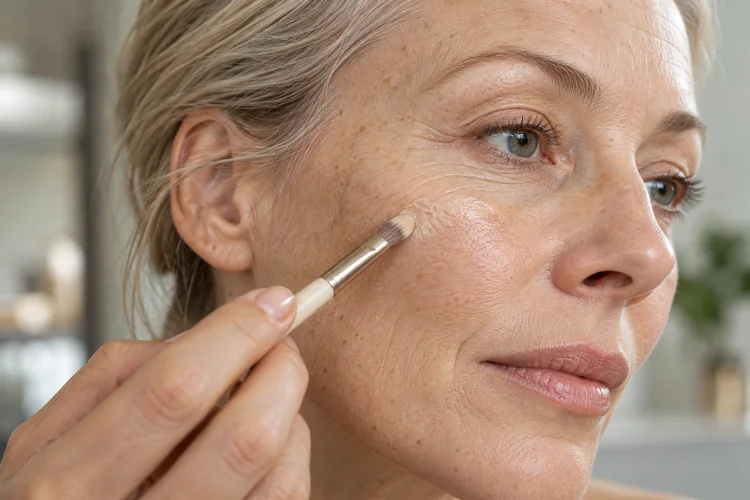
Foundation can match your skin tone perfectly and still look completely wrong. Sometimes the problem is not the shade, undertone, or even the product itself. It is the way that product interacts with the physical texture of your skin.
Smooth areas, visible pores, dry patches, active breakouts, fine lines, and oily zones all reflect light differently. They also respond differently to moisturizer, primer, foundation, concealer, and powder.
A technique that creates a beautiful finish on hydrated skin may exaggerate flakes on dehydrated skin or collect around raised acne.
Understanding how skin texture changes the strategy behind base makeup allows you to stop treating the entire face like one uniform surface.
Modern complexion makeup is increasingly about adapting product texture, coverage, and application technique to specific areas.
The goal is not to erase every pore or line. Real skin naturally has texture. Instead, successful base makeup balances tone and coverage while allowing enough natural detail to remain visible, creating a polished complexion that still looks believable up close.
Skin Texture Matters as Much as Skin Type
Skin type usually describes broader characteristics such as dry, oily, combination, or normal. Texture is more specific.
Someone with oily skin can still have flaky areas. Someone with dry skin can have noticeable pores. Mature skin may experience both dehydration and uneven texture, while acne-prone skin can include smooth areas alongside raised blemishes.
That distinction matters because foundation sits on the surface of the skin.
When that surface is uneven, adding more coverage does not automatically make it look smoother. In many cases, additional pigment makes uneven texture more visable because foundation collects around flakes, pores, bumps, and fine lines.
The smarter approach is to evaluate the face by zones before applying makeup. Look at where the skin feels rough, where it reflects excess shine, and where foundation normally breaks apart.
That quick assessment should determine how you build your base.
Dry and Flaky Texture Needs Flexibility, Not Heavy Coverage
Dry skin often becomes more obvious after foundation is applied because pigment can attach to loose surface cells.
The first priority is therefore hydration.
Vogue’s makeup experts recommend moisturizing preparation and generally favor hydrating, satin, or dewy foundation formulas for dry complexions. Tapping or stippling foundation can also be preferable to aggressive buffing, which may disturb flaky areas.
Give moisturizer enough time to absorb before applying makeup. If the surface still feels extremely slippery, excess skincare can mix with foundation and cause movement or seperation.
When applying the base, begin with a lightweight layer and press it gently into the skin. Avoid repeatedly rubbing a brush across dry patches.
Full coverage is not forbidden, but flexible medium or buildable formulas often make texture easier to manage because you can add pigment only where discoloration needs it.
Powder should also be selective. Dry cheek areas may need almost none, while the nose or forehead can still be lightly set.
Visible Pores Require Optical Smoothing, Not Filling Everything
Large or noticeable pores are another common reason foundation can look less smooth than expected.
The instinct may be to apply a thick layer of pore-filling primer followed by full-coverage foundation and powder. Unfortunately, piling multiple dense products into the same area can sometimes create more obvious texture.
Instead, use thin layers.
A smoothing primer can be pressed into pore-heavy areas, particularly around the nose and inner cheeks. Foundation should then be applied with gentle pressing or stippling motions rather than aggressively swept across the skin.
Modern matte foundations can also combine oil control with flexible, lightweight coverage rather than the rigid matte finishes of the past. Allure notes that newer matte formulas can provide pore-blurring effects while remaining customizable in coverage.
Lighting matters too. Completely eliminating the appearance of pores is unrealistic because pores are part of normal skin structure.
Aim for softer-looking texture rather than perfectly airbrushed skin.
Active Acne Changes Both Coverage and Application Technique
Acne creates a different challenge because the makeup has to address both color and raised texture.
You can conceal redness, but you cannot realistically make a raised blemish physically flat using foundation.
That means excessive coverage can actually work against you.
Start with a relatively thin foundation layer across the entire face. Then use a small brush to place a more concentrated concealer directly over individual blemishes. Blend the edges while leaving the center mostly undisturbed.
This keeps unnecessary product away from surrounding skin.
The American Academy of Dermatology says people with acne can wear makeup but recommends looking for products labeled oil-free, non-comedogenic, or formulated not to clog pores. It also advises applying makeup gently and regularly cleaning brushes.
If acne treatment is making your skin dry, moisturizer can still be important. The AAD notes that common acne treatments can cause dryness and irritation, and an appropriate moisturizer can help the skin tolerate them.
So oily, acne-prone skin should not automatically be treated as skin that needs to be aggressively dried out.
Fine Lines Call for Less Product in High-Movement Areas
Fine lines create another type of texture because they move.
The under-eye area, forehead, smile lines, and areas around the mouth are constantly changing as you speak, smile, or blink. Thick layers of makeup sitting over these areas have more opportunity to crease.
This is why mature or line-prone skin often benefits from thinner, more flexible base products.
Allure’s makeup experts recommend hydrating, buildable complexion formulas and caution against thick, drying concealers that can emphasize fine lines. Lightweight liquid products can behave more like a second skin rather than forming a rigid surface.
Under the eyes, place concealer where darkness is strongest rather than automatically covering the entire area.
Set only where necessary.
A tiny amount of finely milled powder pressed into a crease-prone zone is very different from baking a thick layer under the eye. More powder does not necessarily produce better longevity, particularly when texture is already present.
Oily Texture Requires Shine Management Without Over-Powdering
Oily skin presents almost the opposite problem from dry skin.
As sebum mixes with foundation throughout the day, the complexion can become shiny, foundation may separate around the nose, and pores can appear more noticeable.
The solution is not necessarily maximum matte everything.
Begin with lightweight skincare and allow each layer to settle. Use mattifying or smoothing primer only where oil production is strongest rather than automatically covering the entire face.
A long-wearing or soft-matte foundation can work well through oily areas, especially when applied in thin layers.
Then powder strategically around the nose, forehead, and chin.
If shine develops later, blotting away excess oil before applying additional powder can help keep the base from becoming thick. Continually layering powder on top of oil can create a mixture that emphasizes pores and uneven texture instead of hiding them.
The objective is controlled luminosity, not completely eliminating every hint of natural skin reflection.
Sensitive and Red Texture Benefits From Minimal Friction
Some skin textures are accompanied by sensitivity, redness, or irritation.
Rosacea is a good example. The American Academy of Dermatology explains that rosacea-prone skin can sting or burn when exposed to irritating products and recommends gentle skincare and makeup practices.
This changes application technique.
Avoid repeatedly rubbing foundation across sensitive areas. Pressing makeup gently with clean fingers, a soft brush, or an appropriate sponge usually creates less friction.
Color correction may also reduce how much foundation you need. The AAD notes that green-toned concealer can camouflage redness, while yellow-toned correction may help disguise certain areas of discoloration.
The corrector should remain extremely thin.
If you need a thick green layer followed by several layers of foundation to hide it, the correction itself has become part of the texture problem.
Mixed Texture Means One Foundation Technique Is Not Enough
Many faces contain several texture types at once.
You might have a dry outer cheek, visible pores near the nose, an oily forehead, and occasional blemishes around the chin. Using exactly the same products and quantities everywhere ignores those differences.
This is where zoned complexion makeup becomes useful.
Use more moisturizer on dry areas, smoothing primer around visible pores, minimal foundation over already-clear skin, concentrated concealer on blemishes, and powder primarily where oil develops.
The products do not necessarily need to change dramatically. Sometimes simply changing the quantity and application method is enough.
A damp sponge might be your prefered tool over dry areas, while a small foundation brush can provide precision near discoloration. Powder can be applied with a small brush instead of a large fluffy brush so it does not automatically cover the entire face.
This targeted approach usually creates more natural dimension because different parts of the complexion retain slightly different finishes.
Stop Expecting Makeup to Remove Physical Texture
Perhaps the most important base-makeup lesson is knowing what makeup can and cannot do.
Foundation can change color, reduce visible redness, soften contrast, and create optical smoothing. It cannot physically eliminate pores, acne bumps, deep lines, flakes, or scars.
Trying to completely hide physical texture often leads to increasingly thick layers.
Ironically, those layers may make the texture more obvious.
Instead, focus coverage on differences in color while keeping product thin over raised or uneven surfaces. Use light strategically and allow certain imperfections to remain visible.
Natural-looking complexion makeup is not created by making the skin perfectly uniform. It works because everything looks intentionally balanced.
Sometimes taking away a layer of foundation produces a more polished result than adding another one. That restraint is what makes advanced base application look subtley sophisticated rather than heavily concealed.
Understanding how skin texture influences base makeup makes foundation much easier to control.
Dry patches need hydration and flexible formulas, visible pores benefit from thin smoothing layers, active acne requires precise concealing, and fine lines usually look better with less product. Oily or sensitive areas require their own adjustments as well.
The biggest shift is to stop treating the entire face as one identical canvas.
Study your complexion before applying makeup and identify where texture changes. Then adjust skincare, foundation coverage, application pressure, concealer, and powder by zone.
Try this approach during your next makeup routine: use less product everywhere first, then build only where the skin genuinely needs it. The result can look smoother, lighter, and far more convincingly skin-like.