
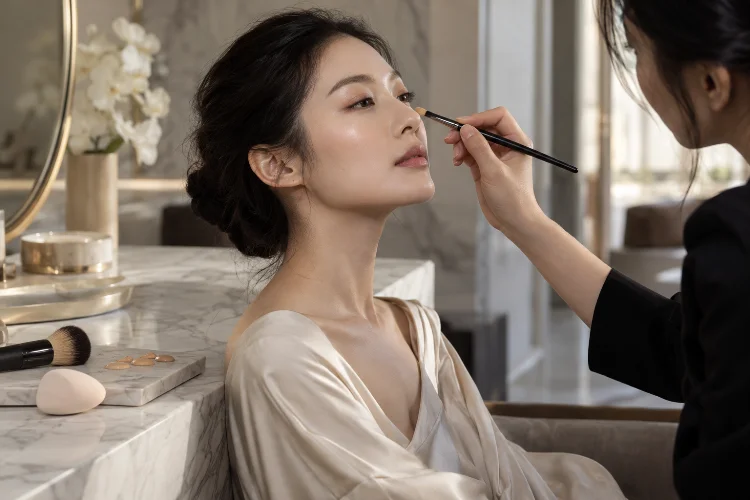
A truly beautiful foundation finish usually does not look like foundation at all. Instead, you notice smooth, healthy-looking skin with natural highlights, subtle shadows, and enough variation to keep the face from appearing flat.
That effect rarely comes from applying one perfectly even layer of full-coverage product. Modern complexion makeup relies much more on strategic placement, thin textures, and gradual buildup.
Advanced foundation layering for dimensional skin-like finishes is essentially the art of using different amounts of coverage across different areas of the face.
Some areas may need almost nothing, while redness, pigmentation, or blemishes may benefit from additional correction.
The technique also considers hydration, foundation texture, concealer, powder, and the way light naturally interacts with the face. When these elements are layered carefully, makeup becomes less obvious even when the overall complexion looks more polished.
The goal is not flawless plastic-looking skin. It is believable skin with controlled imperfections, balanced tone, and natural dimension.
Prepare Different Areas of the Skin Differently
Foundation layering actually begins before foundation.
Skin rarely behaves exactly the same across the entire face. The cheeks may feel dry while the forehead becomes oily. The area around the nose may have visible pores, while the outer face may simply need hydration.
Instead of applying one heavy skincare routine everywhere, prepare each area according to what it needs. Hydrating products can help dry sections look smoother, while lighter moisturizers may work better where oil develops quickly.
Professional makeup artists regularly emphasize skin preparation as part of creating a second-skin finish. Vogue, for example, notes that balanced hydration and thoughtful preparation can help foundation sit more naturally on the complexion.
Give skincare a few minutes to settle before starting makeup. If the skin still feels slippery, pressing a clean tissue lightly against overly moisturized areas can remove excess product without stripping away all hydration.
Build the First Foundation Layer Almost Transparently
The first layer should create balance rather than maximum coverage.
Start with a small amount of foundation around the center of the face, where redness and uneven tone are often more noticeable. Blend outward toward the hairline and jaw so the product gradually becomes thinner.
This creates a natural transition between corrected areas and skin that needs little coverage.
Makeup artists quoted by Allure similarly recommend beginning with a small amount and stretching foundation outward in a thin layer before adding more only where necessary.
Avoid immediately applying another full layer across the entire face. Stand back, look at the complexion, and identify which areas actually still need correction.
You may discover that the forehead already looks fine while only the sides of the nose and lower cheeks need another pass.
That selective approach is what keeps the final base dimensional.
Layer Coverage Only Where the Skin Needs It
The second layer is where precision becomes important.
Instead of using another pump across the whole face, place tiny amounts directly over persistent redness, pigmentation, or uneven areas. Stipple rather than aggressively buffing the product so you do not remove the foundation underneath.
A small synthetic brush can give you extra control. A damp sponge can then soften the edges until the additional coverage becomes almost impossible to detect.
This targeted layering creates an interesting visual effect: the complexion appears consistently even from a normal viewing distance, but close up, some natural skin variation remains.
That variation is useful.
Human skin naturally contains slightly different colors, levels of translucency, freckles, pores, and small shadows. Removing all of those features can make even technically perfect makeup look artificial.
The most realistic base is often slightly imperfect by design.
Combine Foundation Textures With Care
Advanced layering does not always mean using the same foundation repeatedly.
Sometimes two compatible textures can create a better result. For example, a lightweight serum foundation can provide an overall veil while a more concentrated formula adds coverage only around blemishes or discoloration.
Serum-style foundations are often designed to provide flexible, skin-like coverage. Allure notes that makeup artists commonly recommend applying these formulas in thin layers and stippling additional product only where more coverage is required.
However, product compatability matters.
Layering an extremely emollient formula underneath a very dry matte product can sometimes produce separation. Similarly, excessive skincare, primer, and foundation layers may cause makeup to slide rather than bond smoothly with the skin.
When combining formulas, test them on a small area first. If they begin separating, pilling, or forming obvious texture, simplify the routine rather than trying to fix the problem with more product.
Use Concealer as the Highest-Coverage Layer
Foundation does not have to solve every complexion problem.
Once the overall skin tone looks balanced, concealer can provide concentrated coverage exactly where it is needed. This makes it possible to maintain relatively sheer foundation across most of the face.
For a blemish, use a small brush to place concealer directly over the spot. Choose a shade close to your actual skin tone rather than a dramatically brighter shade.
Then blend only around the outer edge.
Under-eye concealing requires a different approach. Rather than covering the entire area with a thick triangle of product, concentrate concealer around the inner corner and wherever shadows are darkest.
This targeted strategy reduces unnecessary buildup while keeping the eye area fresh.
It is also particularly useful when working with textured or acne-prone skin. The American Academy of Dermatology recommends gentle makeup application and advises acne-prone users to consider products labeled oil-free, non-comedogenic, or formulated not to clog pores.
Keep Natural Dimension With Multiple Foundation Shades
One sophisticated way to avoid a flat complexion is to work with slightly different foundation shades.
That does not mean obvious contour stripes.
A shade that closely matches the central complexion can be used through the center of the face, while a slightly deeper version can blend around the perimeter. Makeup artist Hiromi Ueda has recommended this two-shade approach for creating natural dimension without making foundation appear heavy.
The difference between the shades should be subtle.
If the contrast is too strong, you move away from foundation layering and toward visible contouring. The objective is simply to preserve the natural depth that can disappear when one opaque foundation shade covers everything.
This technique can be especially effective around the forehead, temples, outer cheeks, and jawline.
Blend the transition carefully so there is no obvious boundary between shades. When done well, nobody should notice two foundations. They should simply notice a more dimensional complexion.
Powder Strategically Instead of Setting Everything
Powder can extend wear and control shine, but it can also erase the luminosity that makes layered foundation look like real skin.
Rather than setting every centimetre of the face equally, focus powder on areas where makeup genuinely moves or becomes overly shiny.
The center of the forehead, sides of the nose, chin, and specific under-eye areas are common places to start. Leave naturally drier areas or the upper cheeks with less powder when appropriate.
This creates contrasting finishes across the face.
Allure’s makeup experts recommend strategic setting rather than automatically mattifying the entire complexion, particularly when the goal is a fresh skin-like finish.
If oil appears later, blot first. Repeatedly layering powder over accumulated oil can eventually create a heavy, uneven texture.
Use a small brush or puff so powder placement remains controlled instead of spreading product everywhere.
Merge Every Layer Into One Skin-Like Surface
After foundation, concealer, and powder are complete, the complexion should look unified rather than visibly layered.
A damp makeup sponge can be useful at this stage. Lightly press it across areas where foundation appears slightly heavy or where powder is sitting on the surface.
Do not aggressively bounce the sponge everywhere. You are refining the makeup, not starting the blending process again.
A light setting mist may also help reduce an excessively powdery appearance. Allow it to dry before deciding whether the skin needs additional product.
Then inspect the complexion under natural light.
Pay particular attention to the hairline, eyebrows, nostrils, jawline, and areas around the mouth. These locations often reveal buildup that looked invisible under indoor lighting.
Sometimes the best finishing technique is actually subtraction. If one area looks too heavy, remove a little product instead of automatically adding something else.
The finished effect should appear subtley polished rather than obviously perfected.
Avoid Turning Layering Into Product Overload
The term “layering” can sound like permission to use foundation, concealer, powder, primer, mist, and multiple creams in generous quantities.
It is actually the opposite.
Advanced layering means placing smaller amounts of product more intelligently.
Excessive layering can increase the risk of pilling, separation, creasing, and visible texture. It can also make later touch-ups much harder because every new product sits on top of several existing layers.
Clean tools also matter when complexion makeup becomes more precise. The FDA recommends clean hands, properly maintained cosmetic containers, avoiding shared makeup, and discarding cosmetics that develop unusual changes in color or smell.
The simpler and cleaner your layering process is, the easier it becomes to maintain a believable result.
Advanced foundation layering is not about creating thicker coverage. It is about controlling where coverage, luminosity, texture, and depth appear across the face.
Begin with balanced skin preparation and a nearly transparent first layer. Build foundation only where necessary, use concealer for precise correction, preserve dimension with subtle tonal variation, and apply powder only where shine needs control.
Most importantly, allow some natural skin to remain visible.
The next time you apply foundation, resist the instinct to cover the entire face equally. Start with less, examine the result, and add product only where it makes a meaningful difference.
That simple shift can turn a standard foundation routine into a much more refined, dimensional, and definately skin-like finish.